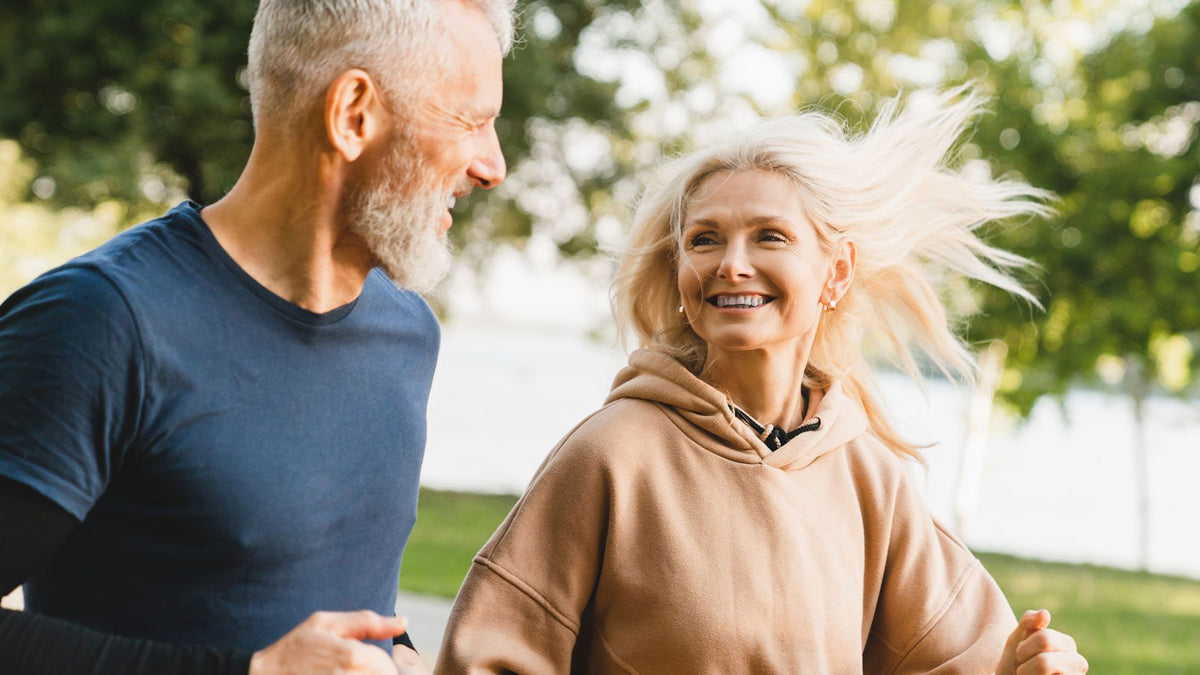
Can we slow down the aging process? In an interview with Professor Dr. Kleine-Gunk, President of the German Society of Anti-Aging Medicine, we learn how we can maintain our health as we age for as long as possible. From the importance of coenzyme Q10 and NAD to vitamin D and omega-3 fatty acids – here you will get valuable tips on how to stay healthy and vital for longer and extend your so-called health span.

About the person:
President of the German Society for Prevention and Anti-Aging Medicine, specialist in gynecology, and author of numerous book publications on longevity.
Medicom: Professor Kleine-Gunk, you are President of the GSAAM, the German Society of Anti-Aging Medicine, and a practicing gynecologist. You have written many books about nutrition, longevity, and anti-aging. Let's talk about healthy aging today. Let's start with something personal: How old are you, and how do you keep yourself fit?
Prof. Dr. Kleine-Gunk: I am 65 years old, so at an age when many people retire. However, it is important for me to remain active, both physically and mentally. I stay fit through sports and try to have a healthy and balanced diet without following strict diets. I occasionally eat meat, and I also enjoy a glass of red wine from time to time. Furthermore, I keep myself fit by continuing to work as a doctor, writing books, and giving lectures worldwide. All these things contribute to my physical and mental health.
Medicom: It sounds as if activity – physical and mental – plays a key role. In your opinion, is that the most important factor for healthy aging?
Prof. Dr. Kleine-Gunk: That is very important in the field of anti-aging. Many think that when they are 65 and retire, they don't have to do anything anymore. But that is a mistake. People who stop being active age faster. Of course, you can relax and take things slower, but total inactivity is a major factor in aging. Shifting down a gear is fine, but stopping completely is like a crime against one's own body.
Of course, you cannot completely prevent us from aging, but we can slow down the process.
Medicom: Let's come to the subject of aging itself. Some say aging is a natural process, others view it as a kind of disease. How do you define aging?
Prof. Dr. Kleine-Gunk: In anti-aging medicine, we actually view aging as a pathological process that can be treated. Of course, you cannot completely prevent us from aging, but we can slow down the process. Aging is the greatest risk factor for many diseases that we die from in the Western world, such as cardiovascular diseases, cancer, or neurodegenerative diseases like Alzheimer's. If you can slow down aging, you also reduce the risk of getting these diseases. So the goal is to influence the aging process to such an extent that we stay healthy for longer.
Medicom: That means we can slow down the aging process. What factors play a role in this?
Prof. Dr. Kleine-Gunk: To treat aging, you first have to understand it. Today, we know significantly more about it thanks to molecular foundations. In 2013, a significant scientific publication, The Hallmarks of Aging*, was published, which lists the most important aging factors. Many of these factors can be influenced, making aging no longer a fated process. Aging is modifiable, and we can do a lot to counteract it.
Among the best-known aging processes are oxidation, stress from free radicals, and chronic, low-grade inflammatory processes, also known as “silent inflammation.” Another important factor is the decline in mitochondrial function – the mitochondria, which supply our cells with energy. Recent research also shows epigenetic changes that influence which genes are active.
Epigenetics is a key factor here: it decides which genes are read, and this process becomes increasingly imprecise with age. Another problem is the accumulation of molecular “trash” in the cells. Harmful beta-amyloid can also accumulate in the brain, which can lead to diseases like Alzheimer's. But through a healthy lifestyle, nutrition, and possibly supplementation, we can counteract this and actively intervene in these processes.
Medicom: Is sports supposed to be the health pill par excellence?
Prof. Dr. Kleine-Gunk: Yes, of course we shouldn't forget sports. It is a very, very important factor in anti-aging. So if you could pack all the benefits of sports into a pill, you would probably already have the ideal anti-aging medication. What happens when we exercise? We consume more energy, and the body notices that, of course. How does it react to that? By producing more energy producers. This means it then produces new mitochondria (the power plants of the cells) to meet the increased energy demand. And that is, of course, also a great way to do something for your mitochondria. So not just keeping the aging mitochondria alive with supplements, but producing brand-new ones by exercising more.
Medicom: How can I support healthy aging through nutrition?
Prof. Dr. Kleine-Gunk: We know what is healthy in our diet. Above all, it is the secondary plant compounds that make fruit and vegetables so healthy. You should consume as much of them as possible. The Mediterranean and Asian diets are certainly a role model.
Medicom: How can I additionally support the cells?
Prof. Dr. Kleine-Gunk: Mitochondria are important because they are the power plants in our cells. They produce energy, ATP (adenosine triphosphate). However, waste products are also generated during this energy production, and these are essentially free radicals. Thus, these mitochondria themselves are subject to an aging process. And when mitochondria age, we see two things happen: energy production decreases and the output of free radicals increases. And that is what older people often experience themselves. They are no longer as energetic as younger people, and they suffer more from this oxidative stress, which is also a major aging factor.
Coenzyme Q10. That is actually a special mitochondrial antioxidant, i.e., a free radical scavenger that primarily targets the mitochondria, so it makes a lot of sense.
Medicom: What can one do?
Prof. Dr. Kleine-Gunk: For one thing, we have coenzyme Q10. That is actually a special mitochondrial antioxidant, i.e., a free radical scavenger that primarily targets the mitochondria, so it makes a lot of sense. On the other hand, we have the generation of energy in the form of ATP, which is produced via the respiratory chain in the mitochondria. At the beginning of this biochemical process is the substance NAD+ or NADH. One approach is to say: “We provide the cells with more of this starting substance, then we have more ATP at the end.” You can do that via NADH, NAD+, and NMN; there is a lot of discussion about that. Ultimately, many of these substances come from the large group of B vitamins. These are still underestimated in Germany.
Medicom: Do nicotinamide and niacin (vitamin B3) also belong to these substances?
Prof. Dr. Kleine-Gunk: Yes, it is, so to speak, a precursor that is metabolized by the body itself into NAD+.
Silent inflammation, i.e., chronic low-grade inflammatory processes, is a very important aging process.
Medicom: What are your other vital substance tips regarding the aging process?
Prof. Dr. Kleine-Gunk: For one thing, there are the classics like vitamin D. 70 to 80 percent of all Germans have a vitamin D deficiency in winter. Omega-3 fatty acids are also a classic, as they are anti-inflammatory and downregulate these inflammatory processes that are associated with aging processes. DHA and EPA are certainly the most important ones. Why do these omega-3 fatty acids actually have an anti-inflammatory effect? Silent inflammation, i.e., chronic low-grade inflammatory processes, is a very important aging process. The inflammatory processes are essentially influenced by so-called cytokines, which are tissue hormones. There are proinflammatory cytokines, i.e., those that tend to promote inflammatory processes, and anti-inflammatory ones, i.e., those that tend to downregulate inflammatory processes.
These cytokines are formed from fatty acids – different fatty acids make different cytokines. Unsaturated fatty acids and omega-6 fatty acids tend to promote the formation of proinflammatory cytokines, which make us age. And the formation of anti-inflammatory cytokines, which counteract inflammatory processes, is promoted more by unsaturated fatty acids, especially omega-3 fatty acids.
So how do these omega-3 fatty acids get into the fish oils of fatty sea fish? Via the food chain. They are first formed in algae. These are then eaten by krill, the krill is in turn eaten by the large fish, and that is how the omega-3 fatty acids finally get into the fatty sea fish. You can therefore start at the beginning of the food chain, i.e., with the algae.
Medicom: What about plant-based alternatives to fish oil, such as algae oil?
Prof. Dr. Kleine-Gunk: Algae-based supplements with omega-3 fatty acids are certainly a very, very good alternative. Algae oil is a good plant-based alternative for people who eat a vegetarian or vegan diet but still want to benefit from the health advantages of omega-3 fatty acids.
Medicom: That is very valuable information. Would you like to leave our readers with any final thoughts when it comes to the topic of “healthy aging”?
Prof. Dr. Kleine-Gunk: Yes, one important thing we haven't covered much so far is the mental attitude toward aging. Many people are afraid of aging because it is associated with physical decline, illness, and the loss of abilities. However, this fear can become a self-fulfilling prophecy. Those who see aging as a threat often become inactive and begin to withdraw. This reinforces the aging process and causes one to age faster than would actually be necessary.
However, if you maintain a positive attitude toward aging and see it as a new phase of life with new possibilities, that can contribute enormously to quality of life. Many people have decades ahead of them after reaching retirement age, and this time should be used meaningfully. You can discover new hobbies, travel, do volunteer work, or learn a new language.
It turns out that we have much more control over our health and our aging than we might have thought.
Medicom: What about our genes? Can you do something despite having bad genes?
Prof. Dr. Kleine-Gunk: Yes, there is good research on this, especially from twin studies from the 90s. Genes play a role in certain diseases and the aging process, but not the decisive one. Most studies say genes are responsible for 20 to 30 percent of the aging process. That means 70 to 80 percent can be influenced by lifestyle. That is very good news. Even those who have inherited bad genes from their parents can compensate for this through a healthy lifestyle. A healthy lifestyle includes nutrition, exercise, stress management, and sleep. By paying attention to these factors, you can minimize the negative effects of bad genes.
It turns out that we have much more control over our health and our aging than we might have thought. These findings should motivate us to make conscious decisions and change our lifestyle in a positive way. Ultimately, it is in our hands how we age and which diseases we might be able to avoid.
Medicom: Thank you for the interview.
• *Editor's note: Hallmarks of Aging translates to “Kennzeichen des Alterns” or “Merkmale des Alterns”. It refers to a list of biological processes and factors that have been scientifically identified as the main drivers of the aging process.
• Are you interested in products containing bioactive Q10? You can find them here!