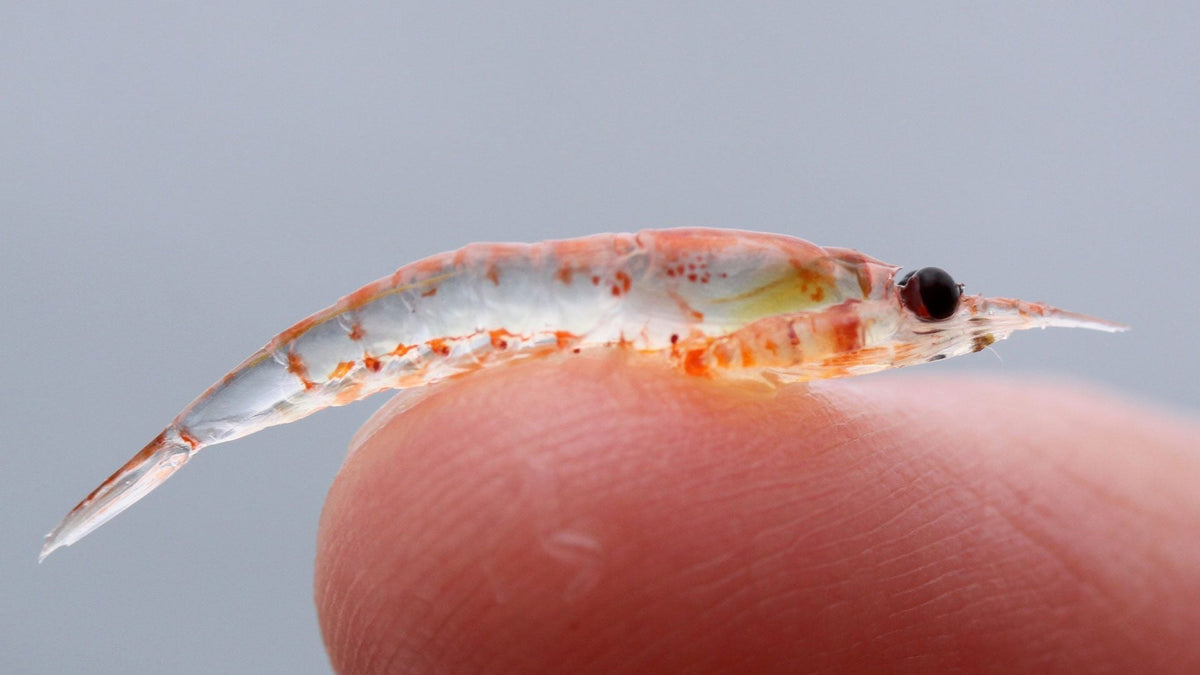
Welcome to the first episode of the Medicom Krill Oil Special podcast. In our special series, every week we will explore the characteristics of a fascinating life form from the depths of the Antarctic: krill. Let us first take a scientific look at this unique creature.
Krill is a group of more than 80 crustacean species that live in the ice-cold waters of the Antarctic and are known as Euphausiidae (yoo-fau-zee-ih-dee). Most krill species belong to the zooplankton and are found in the Southern Ocean.
The shrimp-like Antarctic krill, Euphausia superba, is the most widespread, most common, and arguably best-known krill species. Antarctic krill is also found in high concentrations in the South Atlantic and parts of the Indian Ocean near the Antarctic continent.
But how old does this little crustacean actually get, and how small is it really? Antarctic krill can reach a body length of up to 6 cm and lives for about 6 years on average. That may not sound particularly impressive to us humans, but considering its living conditions, its lifespan is quite remarkable.
Fossil findings indicate that krill has existed for about 30 million years. Over the course of evolution, it has adapted to the specific conditions of the Antarctic and is now an important part of this unique ecosystem.
The reproductive cycle of krill is also fascinating: sexual maturity is reached at 2 years for females and 3 years for males. Mating takes place 1 to 2 months before spawning in November. Adult krill form swarms that can include thousands of animals per cubic meter and color the water red or orange.
After spawning, the females carry their eggs in a sac, the so-called brood pouch, on their bodies. There, the eggs develop into larvae, which are finally released from the pouch. Krill have a remarkable ability to multiply rapidly. Under ideal conditions, a female can produce up to 10,000 eggs in one cycle. This allows for high population density and contributes to the stability of the ecosystem.
Krill: The largest biomass in the world
Krill is not only one of the most common and successful populations on Earth, but it also contains the most powerful proteases and peptidases known. Proteases and peptidases are enzymes that help break down and utilize proteins and peptides in the body. They are important building blocks for the smooth functioning of our organism.
Despite all the knowledge about this fascinating species, much of its survival strategy during the Antarctic winter remains a mystery.
It is suspected that the animals do not build up large fat reserves. Their diet consists of algae that grow on the underside of the pack ice, as well as dead animal and plant remains that they find on the seabed. In times of hunger, when food is scarce, krill cannot rely on fat but must draw on other internal body reserves to survive.
Laboratory studies have shown that Antarctic krill can survive for up to 200 days without food by shrinking and consuming its own body to maintain its metabolism. It is believed that the reduction in metabolic rate also allows the krill to survive the winter without food intake.

Why is krill red? That's a good question! Krill contains pigments that give it its characteristic reddish color. These pigments come from the food the krill eats, mainly unicellular algae and phytoplankton. It is possible that these pigments also serve as protection against harmful UV radiation in the upper layers of the water.
When it comes to sustainable krill fishing, there are organizations committed to protecting krill and Antarctic waters. One of these organizations is the Commission for the Conservation of Antarctic Marine Living Resources, or CCAMLR ("see-kam-ler"). The CCAMLR was founded in 1982 with the goal of preserving the marine ecosystems of the Antarctic and promoting sustainable fishing practices. It monitors krill fishing and sets catch quotas to ensure that stocks are preserved and the delicate balance of the Antarctic is not disturbed.
We hope this scientific insight into the world of krill has sparked your interest. Krill is a fascinating creature that teaches us a lot about adaptability and the importance of the small in the grand scheme of things.
• Would you like to learn more about krill oil? You can read all posts and podcasts about krill oil and omega-3 fatty acids here.