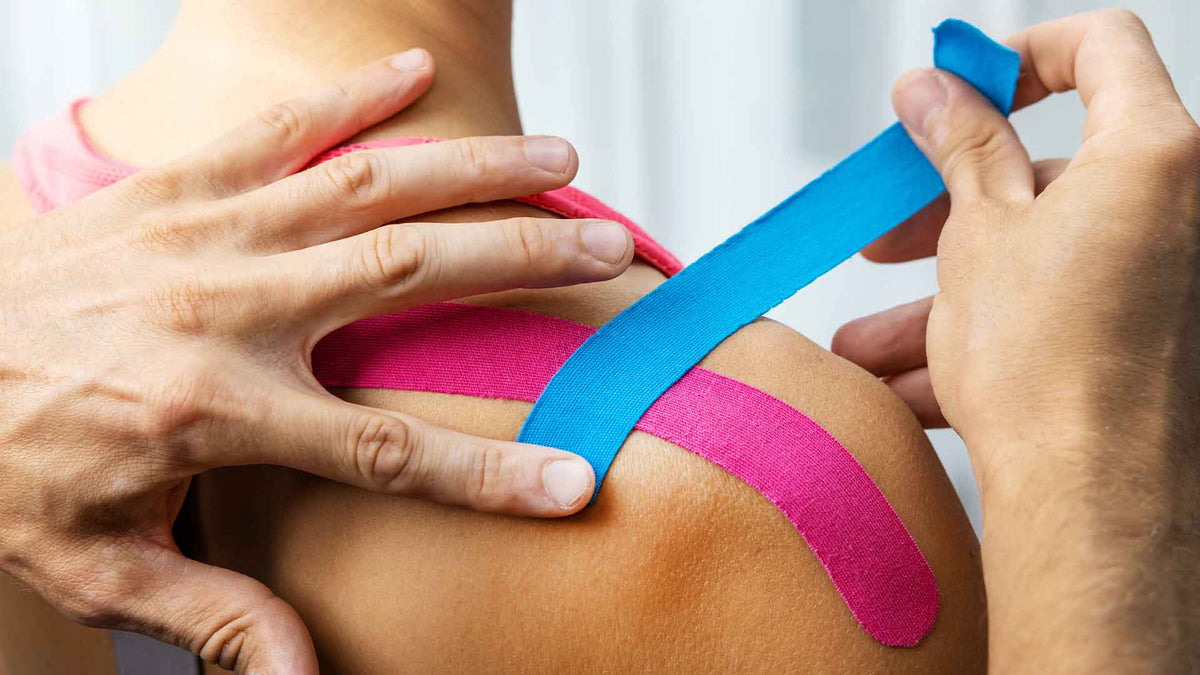
Who detoxifies and cleanses our body? The lymphatic system takes on these tasks, among others. With taping or Kinesio-Taping, we support these bodily functions. Read or listen to an exciting podcast interview with physiotherapist Yvonne Burkert. Her area of expertise is taping. The interview was conducted by Ana Lorena Gómez, Managing Director of Medicom.
Medicom: Hello Yvonne, welcome to the Medicom Health Podcast. I am so happy that you are here! We have known each other for a while now. Even during our first meetings, we realized that we have a lot in common. Not just the fact that you take and advocate for dietary supplements, but also that health must be viewed as a big picture.
Welcome, Yvonne!
Yvonne Burkert: Thank you very much! I am very happy to be a guest on the Medicom Health Podcast! My name is Yvonne Burkert, and I have been a physiotherapist for 21 years. In 2002, I completed my physiotherapy studies with a Dutch Bachelor's degree. We were the first in Germany at the time to complete the physiotherapy degree program. This was conducted by the Fresenius University of Applied Sciences in Idstein in cooperation with the University of Applied Sciences Utrecht/NL.
You could say that we were introduced to holistic thinking during our studies. For example, when looking for the cause of shoulder pain, not just focusing on the shoulder, but including the whole person.
This approach has always fascinated me, and I have continued to expand and develop it throughout my career. However, I also quickly realized that the holistic and long-term approach is not desired in all areas of physiotherapy, for example, in the field of competitive and professional sports, where I naturally wanted to work at the very beginning of my career and worked for a long time. Since I came from competitive sports myself (tennis), I naturally wanted to work with athletes. However, different laws apply there – namely to get fit again as quickly as possible, no matter how.
I realized relatively quickly that this did not correspond to my work philosophy. I want to help my patients get fit again as quickly as possible and also maintain that in the long term, relative to the entire body. And not just for the next day, the competition, or the game, etc. Often in professional sports, it is not about the person, but about their performance – the money factor plays a big role!
Medicom: What significance do disease prevention and rehabilitation have for you?
Yvonne Burkert: A very great one! This was part of the reason why I stopped working as a sports physiotherapist in competitive and professional sports. I focused my work on working holistically with the body. The goal is to build long-term health, stability, and performance of the body.
The topic of rehab plays a huge role in this. It was very important to me to bring the patient's body into the healing process as quickly as possible after surgery, trauma, or a fall, etc. And in such a way that the body does this as much as possible on its own.
To achieve this, you cannot get around the lymphatic system. Our lymphatic system is the body's sewage treatment plant. It ensures that inflammatory substances, viruses, bacteria, pollutants, etc., are filtered out of our system. If we activate this system immediately after surgery, trauma, or a fall, we can cut the healing time in half. Working with the lymphatic system has inspired me.
A well-functioning lymphatic system is an important building block for a well-functioning body.
I always explain my work with it like this: In your car, the battery is dead, and I provide jump-starting with the activation of the lymphatic system. Not to mention that for most people, the lymphatic system only works at 60 to 70 percent. A well-functioning lymphatic system is an important building block for a well-functioning body. An important aspect, because our immune system is also attached to the lymphatic system! Working with the lymphatic system is a common thread that runs through my holistic treatment method. My intention is to bring the lymphatic system and its function into people's focus.

Medicom: Do your patients come to you already with deficits, or do they mostly have a focus on prevention and rehabilitation?
Yvonne Burkert: Most of my patients, not all, I meet "with their heads under their arms." The overall condition is not really good. The reason for our meeting is usually a previous surgery, trauma, or severe pain. What I also observe very often is that many arrive with a non-existent, sensitive body awareness. This is shown by the fact that they are initially overwhelmed by my precise questions. Questions like: "Where exactly is the pain?" In the muscles, bones, tissue, tendon, capsule, etc.! Or "What is the pain like?" Stabbing, pulling, pressing, burning!
In the course of my holistic treatment method, the patient learns to know their body better and can thus better handle it and react to it. It is very important to me that the patient understands the complexity of their body and that – when we have gotten their system running again – independent, rapid healing is possible. This makes the entire body more powerful and resilient!
Medicom: Therapies for the prevention of illnesses and ailments should be part of regular health care. This applies both to people who need to be treated after an operation or an acute trauma and to people who spend a lot of time at the computer or engage in competitive sports. To anchor this understanding in the population, people must be taught in a sustainable way what positive effects taking care of the body can have on their health. How could this be achieved?
Yvonne Burkert: I find it very unfortunate that most people only take care of their bodies when there is an acute problem. I am very often asked by friends and family why I am going to the osteopath and physiotherapist, etc., again. For me, it is very important to convey to people that regular maintenance of the body, inside and out, is part of achieving optimal health!
Medicom: It is understandable that some people consider such approaches a luxury. Fortunately, this attitude has changed in recent years, and it has become easier to think about your personal well-being in this way.
Yvonne Burkert: My motto: My body is my capital, and not just because I am self-employed. If we don't take care of our bodies regularly, our lives are much more restricted. We do it for our cars, don't we? A change in thinking must take place, especially in the older generation. They still assume that everything will heal and get better on its own. They underestimate the importance of bodywork and its effects.
Regular therapies improve physical condition and keep the body fit. An example of this is my oldest patient – he came to me in his early 80s, or rather, his son brought him to me. In his opinion, he didn't need physiotherapy because he had nothing – those were his words! After the first two treatments, however, he realized that the regular treatment does him a lot of good, he walks much more upright, and he became much fitter again. He has now turned 90, and his goal is to get back on the cross-country ski trail.
Medicom: We have a lot of lovely customers who are over 90 years old and write us very nice letters. 103 is our oldest customer. They all firmly believe that what they are doing is good for them. It involves holistic thinking. If you are completely convinced of one thing, you think similarly about other therapies. Is there a difference between taping and Kinesio-taping? And what does Kinesio-taping have to do with the lymphatic system?
Yvonne Burkert: I first came into contact with Kinesio-tape over 15 years ago. Before that, I only knew or used the white, rigid tape, which serves to prevent a painful movement from taking place. That serves to immobilize! Similar to a cast.
The Japanese man Kenzo, who developed the Kinesio-tape in 1970, followed a different, new philosophy. By applying elastic tape bands to a stretched structure (muscle, tendon, fascia, tissue) so that movement is not restricted but at most slightly stabilized, you promote blood circulation and stimulate metabolism. This happens through the micro-massage that occurs under the Kinesio-tape. In other words, everything that has accumulated in the various structures can be transported away through movement! The body's self-healing is activated and stimulated.
Kinesio-tape differs from conventional tape in its elasticity (130 to 180 percent). The surface consists of a cotton material, and on the back is an acrylic adhesive that activates its adhesive strength through body temperature. Kinesio-tape is available for different needs. There are sports tapes that are particularly durable – increased sweating is no problem! Therapy tapes for everyday use or sensitive tapes that are particularly skin-friendly.
The wearing time of Kinesio-tape is three to four days; you can shower, swim, and bathe with it! Afterwards, you should only blow-dry it, as the cotton material soaks up water! To avoid skin irritations like blisters, you should remove the tape at the first signs of itching, etc. Furthermore, it is very sensible to communicate with your body while wearing it to see if it likes it. It doesn't always have to be purposeful and sensible, and not every day is the same!

Medicom: Can one say that it has become a trend to wear these colorful tapes, which are sometimes applied like a fascination and look almost like fashion jewelry?
Yvonne Burkert: I would say that wearing Kinesio-tape has become a trend since professional athletes on TV increasingly wear the colorful bands on their skin. Since the demand is so high, there are now many companies that offer it. It is even offered in discount stores. In my opinion, the quality differences are therefore very, very large!
It is very important not to start your own attempt, but to have it shown to you by a professional (physio, therapist, doctor). Especially tailored to your individual clinical picture. It is also important to get advice from an expert on the choice and handling of Kinesio-tape in order to achieve a positive effect!
Medicom: That means a self-performed Kinesio-taping application without the right knowledge and skill can lead to, for example, taping in the wrong drainage direction and thus rather worsening the problems than solving them?
Yvonne Burkert: It is important that you are shown how to apply the tape correctly by a professional or a qualified therapist. Since last year, I have been offering workshops like #tapethatbackforgood, where you learn how to tape yourself correctly and effectively, specifically for your individual clinical picture. I try to teach participants the correct handling, usage, and the right choice of tape.
It is important to seek professional advice and not rely on unqualified instructions from YouTube videos. Since every person has individual problems, it is important to advise every patient individually. Taping can be uncomfortable, but you don't have to endure it. If it feels weird, it's better to remove the tape.
Medicom: What is the reaction of older people to Kinesio-taping? How is it perceived and accepted by them? Would they try it, and do they understand what is happening?
Yvonne Burkert: It is important to consider the differences between skin types, especially in older people, whose skin can be more sensitive. In older patients, blood thinners and other factors must also be taken into account. Caution is advised with sensitive skin, as the adhesive can be too strong.
For sensitive or thinner skin, I use Kinesio-tapes suitable for this, such as the sensitive variant or beauty tapes, which are much more skin-friendly in terms of adhesive. I recommend that in case of skin problems like allergies, psoriasis, or similar, one should generally refrain from using Kinesio-tape. There is a possibility that it may lead to irritation and inflammation. For every patient, one must evaluate the situation individually, and it depends strongly on the circumstances.
Medicom: What are the biggest challenges for you in working with other professional groups?
Yvonne Burkert: I have a treatment method that I have been using successfully for many years, and it is not easy to find acceptance for it. I work with surgeons and doctors who have lain on my table themselves and convinced themselves of the effectiveness of my treatment on their own bodies. The holistic approach or working directly with the lymphatic system (one to two days) after an operation, trauma, etc., was and is new to many doctors. But the result, which is reflected in the significantly faster and better healing, convinces the doctors and surgeons in any case. And the cooperation runs on a very great and effective level – for both sides!
By activating the lymphatic system, I can shorten the healing time. It is important to activate the lymphatic system immediately after an operation or injury to avoid swelling and inflammation.
By activating the lymphatic system, I can shorten the healing time. It is important to activate the lymphatic system immediately after an operation or injury to avoid swelling and inflammation. It is also important to make an appointment for lymphatic drainage immediately after the operation to activate the lymphatic system. Waiting until swelling or inflammation occurs is less effective. However, many hospitals do not offer this type of therapy.
Medicom: Is there a change in the thinking of doctors towards faster recovery through active movement instead of just lying still?
Yvonne Burkert: I think this rethinking has definitely taken place, but it has not yet reached everyone. It is very clear that you hardly see people with casts anymore. Today, mainly only splints are worn that allow and support movement.
Pain-free movement contributes to the healing process because it causes injured areas to be supplied with blood, including the metabolism starting to work again, and everything that doesn't belong there is transported away.
My task is usually to take away the patient's fear that if they don't feel pain, everything is okay and they can trust their body.

Vitamin C Shot 1,000
High-dose, liposomal vitamin C drinking ampoules
Medicom: Would you also consider a type of face taping based on the approach of lymphatic drainage? And what is your take on the new trends like face masks or pads that you stick to your face? What is your opinion on that? Do they really have an effect? How about you, have you tried that before?
Yvonne Burkert: I think the beauty trend – no matter in what form – has always existed. However, I think that optical beauty has reached a very high level today. Regardless of whether it's a man or a woman. And the age limit has also dropped significantly. You can even find 12- to 13-year-old girls in drugstores buying face masks and eye pads, etc.! I have noticed from my perspective, since I am now also newly offering face-taping workshops, that the interest in the workshops is much higher than in my "normal" #tapethatbackforgood workshops, in which it is, for example, about how I tape my knee correctly and effectively.
I have newly included face taping workshops, #tapedichschön, in my program since the beginning of the year. Here, too, the lymphatic system is an important building block in my workshop. Participants receive an overview and education on topics related to the face: “What is the lymphatic system? What are its functions? And how can I activate it?” Swelling around the eyes and increased wrinkle formation can be a sign of increased water retention.
By independently activating the system through smoothing movements and applying special face tapes, this process can be prevented or halted. This is really a very exciting topic that is also becoming increasingly well-known! But here, too, the rule applies – please have it shown to you by an expert, do not try it yourself!
Medicom: Can I use tape to reduce my frown lines and make my face look more beautiful? How could I integrate that into my everyday routine?
Yvonne Burkert: Yes, there are special tape applications for reducing frown lines. Taping can be incorporated into your daily routine just like dietary supplements, in the same way we do with brushing our teeth. And certain dietary supplements, for example with collagen, can also provide additional support from within here.
Medicom: Just as I pay attention to proper clothing when exercising to avoid injuries, I can learn from you how to incorporate taping into my daily routine, just as I would when using a good cream and taking care to cleanse my skin properly. In your workshops, you show which tape is suitable for which application and how to apply it correctly on the face, regardless of which wrinkle one wants to get rid of, right?
Yvonne Burkert: In my workshop, you get a complete offering so that you understand what you are doing! You also learn what you can do additionally to support your skin, for example through vitamins and dietary supplements. I offer a holistic package and take all these aspects into account in my workshop.
I also give you an insight into how important it is to additionally support your body with certain substances. Such as the fact that vitamin C plays an important role in accelerating wound healing. Or that magnesium is very important for physical and mental regeneration.
My goal is to teach people to communicate more with their bodies again and to find out what is good for them. Perhaps also in a natural way, without injections or pills.
Medicom: One challenge in conveying this topic is that not all people have the same practical experience. How do you deal with this challenge? Do you simply carry on and spread the message that one can actively support the health of one's own body even without pills and injections?
Yvonne Burkert: This interview offers a great opportunity to get the topic out there and potentially reach a larger target group. It is nice to be able to talk about it here to perhaps trigger an “aha-moment” for some listeners and readers, leading them to search for information themselves or even approach their therapist or alternative practitioner about the topic.
Medicom: You have brought us two kinesio tape examples…
Yvonne Burkert: I have been working with kinesio tape for more than 15 years and have noticed that the quality varies greatly between different manufacturers. I have stuck with the company Pino because, for me, they offer the best quality and the largest range of different tapes for different needs.
Skin compatibility is very high, which means that no blisters form under the tape! It holds well, is water and sweat-resistant, and stays in place even during physical activity. I know many therapists who confirm this to me. Originally, kinesio tape was only available in the colors turquoise, pink, skin-tone, and black; each color had a special function and meaning.
Turquoise was energy-depleting and suitable for swelling! Pink was for energizing when a muscle had atrophied. Skin-tone was more neutral, and the black tape was considered the strongest tape! In the meantime, the range of colors and patterns is huge. Very trendy at the moment are rainbow colors and tiger or giraffe patterns. I let my patients decide which color and pattern they prefer.
Pino now also has a cotton-hemp tape in its kinesio tape series. It is made of hemp and has a different, particularly sensitive skin compatibility than other materials.
The price can be an indicator as a quality feature when deciding which one to take! Tapes starting at ten euros should have better quality than tapes for three to five euros from the discount store.
Medicom: What happens if the sensitive kinesio tape variant is not sensitive enough for facial taping?
Yvonne: For my face tapings, I use beauty tapes made especially for this purpose, which have a significantly softer surface, a very sensitive adhesive on the back, and do not possess maximum elasticity! Elasticity is not needed for tape applications on the face.
Through my increased preoccupation with face taping in relation to wrinkle and swelling reduction on the face, another topic has opened up for me where one can help with tape on the face. The very big topic of the jaw or teeth grinding, pressing, and clenching at night!
The jaw muscle is the strongest muscle we have in our body. When we tighten it increasingly at night due to stress, anxiety, and overload, it has major negative effects on our teeth, jaw, and neck. Everyone who owns a bite guard for the night knows what I am talking about.
Through special tape applications, one can significantly relieve the jaw and sleep much more relaxed through the night! However, it is again important to have this shown to you by a professional.
We also offer an interdisciplinary workshop on this topic (with occupational, physical, and speech therapists)! This is intended to help people sleep relaxed again! Sleep is one of the most important ways for our body to regenerate. Due to stress, however, it is often difficult to find a good night's rest. To improve this, it can also be helpful to take magnesium half an hour before going to bed. This can contribute to a better night's rest.
Medicom: Thank you very much for the interview.
Yvonne Burkert: Thank you very much for having me, and until next time.
Would you like to receive more information about health products? You will find what you are looking for here.
Further information about Yvonne Burkert can be found here:
Website: http://burkert-physiotherapie.de/
Workshop: Tape that Back for good http://burkert-physiotherapie.de/wordpress/workshops/
Ergonomics: http://burkert-physiotherapie.de/wordpress/kooperationen/
Facebook group: https://www.facebook.com/groups/144141038936818/?mibextid=6NoCDW