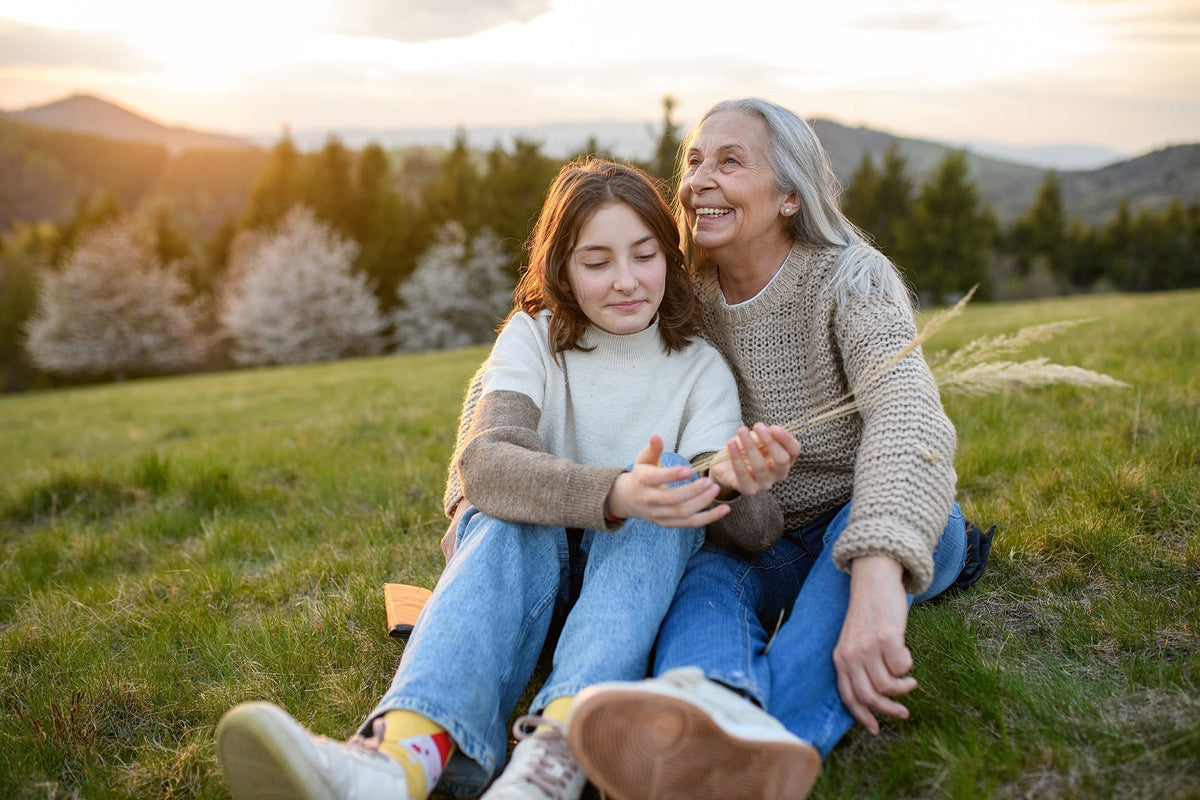
Journalist and non-fiction author Diane Hielscher explains in the Medicom podcast interview why happiness is not a coincidence, how getting older becomes an opportunity for a new quality of life – and the role that good relationships, vital nutrients, and self-efficacy play in this.
About the guest:
Diane Hielscher, happiness expert: "Being happy is not an innate ability, but something you can learn." Diane Hielscher is a radio journalist, presenter, author, and also a podcaster. In her book, "Sei glücklich, älter wirst du sowieso" (Be happy, you’re getting older anyway), she delves into happiness research and explores topics such as neuroplasticity and mindfulness to find answers on how a fulfilling life can be achieved well into old age.
🎧 What to expect in this expert interview:
Having luck versus being happy
Why happiness is not the same as chance – and why "being happy" is a skill we can train. (Minutes 1:30 – 3:05)
Low points are part of a happy life
Crises, grief, and a fulfilling life (3:06 – 4:48)
The image of aging
What stands in our way socially (4:49 – 8:27)
The U-curve of satisfaction
A scientific model of the satisfaction curve as we age (8:28 – 11:25)
Relationships as a health factor
Findings from the Harvard study (11:26 – 14:17)
Neuroplasticity
How we can actively shape our brain (14:18 – 18:39)
Loneliness and health
Why connection is so important (18:40 – 24:25)
Experiencing flow – at any age (24:26 – 29:08)
Learning, curiosity, and mental fitness (29:10 – 32:16)
Self-care in everyday life
Exercise, nature, and nutrition (32:17 – 35:40)
Nutrition and vital nutrients for happiness and well-being (35:41 – 37:45)
Healthy routines, healthy habits
How to maintain them (37:46 – 40:43)
Self-efficacy and purpose
What really sustains us (40:44 – 45:24)
Medicom:
Welcome to the Medicom Health Podcast. My name is Gina Pellarini. Today's guest: Diane Hielscher. Hello, it's nice that you have time for us.
Diane Hielscher:
Hello, my pleasure. I am happy to be here.
Having luck versus being happy
Medicom:
You are a radio journalist, presenter, author, podcaster, and also the founder of LifeXLab.de, a platform for positive thinking, mindful aging, and a higher quality of life. For many years, you have been dealing with questions that concern us all: How do we stay fit for a long time? What makes us happy? And how can we shape the aging process with more ease, courage, and joy?
You have written a book about this: "Sei glücklich, älter wirst du sowieso" (Be happy, you’re getting older anyway).
Let's start with the fundamental question: What actually is happiness? Is it the opposite of bad luck? Is it perhaps success or satisfaction – what exactly is happiness?
Diane Hielscher:
That is a bit complicated in the German language because we have two types of happiness. There is "Glück haben" (having luck) – like winning the lottery or accidentally finding a ten-euro note on the street. That is "luck" in English.
And then there is "glücklich sein" – the feeling of happiness, "happiness." That is more like a verb: something we can practice every day. It’s not something that just happens by chance or doesn’t.
I like to compare it to playing the violin: You don't wake up in the morning and just know how to play the violin. You decide to do it, you practice, you take lessons, you stick with it – over years. You go through low points; it’s not the same every day.
And it's the same with happiness: It is fundamentally a skill. Something we can practice if we want to.
There is "glücklich sein" – the feeling of happiness, "happiness." That is more like a verb: something we can practice every day. It’s not something that just happens by chance or doesn’t.
Low points are part of it: Crises, grief, and a fulfilling life
Medicom:
Let's stick with "happiness," with being happy. Would you describe yourself as a happy person? Or have you had your own low points?
Diane Hielscher:
I’ve had many low points – like every human being. But that doesn't exclude happiness.
I am currently reading a lot in the Harvard Study of Adult Development about a good life. And one important point is: Low points are part of being happy.
It’s not as if you say: "Someone I love has died – so I cannot be happy." A fulfilling life includes loving people, missing them, being sad when relationships end or when the children leave home.
But these low points are part of an intense life. And many people say at the end: "I was satisfied and happy – also because of these low points, because they are part of it." Happiness is an intensely lived life. And that includes grief.
Medicom:
When there is grief, you can probably view the path from the valley to the next mountain peak differently, right?
Diane Hielscher:
Yes. If one were always just "normally happy," one would have no sense for ups and downs anymore.
The image of aging: What stands in our way socially
Medicom:
Why did you decide to write about happiness – and especially about happiness in old age?
Diane Hielscher:
I previously wrote a book about love, triggered by a breakup. I was doing poorly, which is why I delved very intensively into neurology, psychology, and also mindfulness: What happens in the brain? How does meditation change our experience? I applied many things and realized: It works, and I am truly doing well. And then the thought came: "I love life. What a shame that it ends at some point." Aging doesn't start suddenly; it's a process. Wrinkles appear, and for me, at 46, perimenopause.
Medicom:
You write right in the introduction: Aging is often associated with negative aspects. What exactly do you criticize about the societal discourse?
Diane Hielscher:
For example: That I automatically see wrinkles as negative is the result of a society that says: "Wrinkles are bad." In other cultures, it is a mark of distinction: You have lived intensely; you are in a phase of experience and wisdom.
In the Western world – the USA, Europe, also shaped by Hollywood and social media – aging is often portrayed as something one must fight. Women in particular are supposed to "iron themselves smooth," as if aging were something to be ashamed of.
For me, it’s about getting back into joy and asking: Who am I while I age? How can I be happy and fit? And how can I work with my body in such a way that I feel good? On this journey, I discovered how many possibilities we have – and I love having possibilities.
The U-curve of satisfaction
Medicom:
There is this U-curve of satisfaction: between 40 and 50, your mood is in a valley; later, it goes back uphill. Is that true?
Diane Hielscher:
That is a model from happiness research. Mentions include Andrew Oswald (University of Warwick) and David Blanchflower (Dartmouth). People were surveyed, and it was observed that in the "rush hour of life," the feeling of happiness is often at its lowest – because of responsibilities: job, children, house, caring for parents.
The interesting thing about this: Different researchers have found similar curves. But there are also studies that contradict the model. For me personally, the model doesn't fit – my curve is different.
Relationships as a health factor: Findings from the Harvard study
Medicom:
There is the statement: Whoever had a good social environment at 50 and was happy in their relationships is healthier at 80 than someone who was unhappy. What is behind that?
Diane Hielscher:
That comes from the Harvard study that has been running since 1938. People have been surveyed for decades about: relationships, health, lifestyle, feeling of happiness. Later, partners were also included – very late, but still. And the central result is: People who at 50 have the most stable, nurturing relationships – not just romantic ones, but also with friends, neighbors, children – are more likely to be alive at 80, are physically fitter, and have less incidence of dementia or Alzheimer's.
That is the core of this study. Many young people wish for money, success, status. But in the end, it’s always about interpersonal relationships – those keep us the healthiest.
But in the end, it’s always about interpersonal relationships – those keep us the healthiest.
Neuroplasticity: How we can actively shape our brain
Medicom:
You write that happiness can be trained. How do I realign thoughts? You often speak of neuroplasticity – what does that mean?
Diane Hielscher:
We shape our brain through what we read, hear, and say every day, what conversations we have, and what media we let in. If I constantly consume catastrophe reports, I shape my brain for catastrophes.
We have a negativity bias: Negative things catch our attention more strongly.
Medicom:
Why is that?
Diane Hielscher:
That is evolutionarily determined. Our ancestors had to recognize dangers – saber-toothed tigers and such. Whoever saw the negative first survived. Today, we can use this knowledge: Yes, there is murder and war in the news – but around me, there are also people who help each other. When I get involved, I meet wonderful people who do good things. That is rarely reflected in the media.
Neuroplasticity means: The brain remains malleable. Synapses are constantly being formed anew. I can build "highways" for hope, ideas, and possibilities – or for fear and mistrust.
I like to use the image of a flashlight in a dark forest: I decide where I shine it. I see that section – but I hold the flashlight myself.
Neuroplasticity means: The brain remains malleable. Synapses are constantly being formed anew. I can build "highways" for hope, ideas, and possibilities – or for fear and mistrust.
Loneliness and health: Why connection is so important
Medicom:
Let's come to the topic of loneliness: In Germany, many people feel lonely – I noted down 26 percent. What does loneliness have to do with health?
Diane Hielscher:
Loneliness is a subjective feeling – and more and more people report it, including young people. People used to think it was primarily an issue in old age.
Research says: Loneliness is about as unhealthy as 15 cigarettes a day.
Medicom:
Wow.
Diane Hielscher:
Because the body is on high alert: If I feel lonely, it acts like permanent stress.
And importantly: You can be lonely even if you are in a relationship, even if you have a family, even if you have many people around you. Loneliness has a lot to do with whether you feel connected.
Medicom:
Shame is also involved there. People are ashamed of being lonely.
Diane Hielscher:
Exactly. A first step is: naming it. "Name it to tame it." If I admit to myself, "I feel lonely," I have options for action.
Then it's about getting to know yourself: sensing needs, listening, maybe keeping a journal, silence, meditation. There are also services like loneliness helplines where people speak to each other or read to each other.
And sometimes the root is also that we don't listen to ourselves. Many think: "No one listens to me" – but perhaps we don't listen to ourselves. If I have a connection to myself again, real closeness to others can develop. It’s not about guilt for me – I don’t like that word. But sometimes we are part of the cause of our feelings.
Many think: "No one listens to me" – but perhaps we don't listen to ourselves.
Experiencing flow – at any age
Medicom:
You write how important it is to remain active, to be creative, and to be in a flow state. Why is that so important?
Diane Hielscher:
Because we humans can constantly live in the past or the future – and we are happiest in the here and now. Flow is a state in which we are completely in the now because we are absorbed in an activity.
People often try to create "now" artificially – with extremes or distraction. Flow is the healthy variant: a state in which worries have no place.
The researcher who made flow famous was the Hungarian-American psychologist Mihály Csíkszentmihályi. He conducted many interviews – with artists, athletes, scientists – and showed how healing this state is.
Medicom:
And if I am older and not so fit anymore – how do I find my flow moment?
Diane Hielscher:
There is a nice story in a book by Mihály Csíkszentmihályi. His brother was a hobby geologist. In his old age, he would sit at his desk in the morning, identifying rocks and minerals – and suddenly it got dark. He thought a cloud had passed in front of the sun. But it was evening. He had been in the flow all day long.
That shows: Flow has nothing to do with age. It’s about finding something that truly interests you.
Medicom:
So, I have to find my topic that I am enthusiastic about – no matter how old I am.
Diane Hielscher:
Exactly.
We are happiest in the here and now. Flow is a state in which we are completely in the now because we are absorbed in an activity.
Learning, curiosity, and mental fitness
Medicom:
Curiosity and learning – why is that so important?
Diane Hielscher:
Because it’s the gym for the brain. Physically, strength training is great – especially in old age. But mentally, learning is the training.
There are studies with groups: one consumes passively (television/radio), one does moderately new things (puzzles/games), and one learns complex new skills (e.g., digital photography or a new language).
Those who learned complex things felt happier, had more energy, and showed more positive changes in the brain. And that also protects against dementia. If, on the other hand, we adopt societal beliefs: "I am too old for that," then we learn less – and break ourselves down. But: It is never too late.
Curiosity and learning is the gym for the brain.
Self-care in everyday life: Exercise, nature, and nutrition
Medicom:
What does self-care mean for people who have always been there for others? How do you say: "Now it's my turn"? You mention exercise, nature, nutrition.
Diane Hielscher:
First step: get back in touch with yourself. If you have only been there for others for a long time, you know their needs perfectly – but you often don't know your own anymore.
That works well through silence: 10 minutes in the morning, simply sitting, without having to have anything "happen." We have forgotten how to go into silence. But there it becomes clearer what we need. And then you can look: What is good for me? For nutrition, for example: I learned that a protein-rich breakfast helps me keep my blood sugar stable.
If I eat toast or sweets on the go, I am quickly hungry again and get shaky. If I make myself yogurt with nuts, seeds, and fruit, I stay full for a long time and have stable energy.
Important is: out of joy – not out of compulsion. Nobody "has to" do anything. But when you notice that you are feeling better, that is a nice motivation.
In silence, we get in touch with ourselves.
Nutrition and vital nutrients for happiness and well-being
Medicom:
What does nutrition have to do with happiness?
Diane Hielscher:
Very simple: Energy. If I am better nourished, I have more strength to deal with these topics, to get into creativity, into the flow.
Deficiencies can trigger a downward spiral: tired, less exercise, less energy, worse mood.
Medicom:
You also talk about vital nutrients in the book. Which ones?
Diane Hielscher:
You have to have values tested. For me, it was Vitamin D and iron; in addition, I take creatine, and I have B-vitamins checked.
If you are constantly tired, lacking energy, or in a bad mood, it can make sense to have that checked medically.

Healthy routines, healthy habits
Medicom:
And how do healthy habits become a routine?
Diane Hielscher:
Habits are seated differently in the brain than knowledge. There are cases in which people after a trauma "no longer know" things, but habits still function.
New habits are created through regularity. People often say two to three months, but the decisive factor is the actual frequency.
If I do something daily, it establishes itself faster than if I only do it once a week. It’s like brushing your teeth: no motivation needed – it’s just a habit.
Medicom:
So: just do it, don't listen to your weaker self.
Diane Hielscher:
Exactly.
Self-efficacy and purpose: What really sustains us
Medicom:
Looking back: What would you tell your younger self? And looking forward: How would you like to age?
Diane Hielscher:
To my younger self, I would say: “Keep going. Try things out.” I have no regrets.
What people often regret at the end of their lives is the things they didn’t do – that they didn’t dare. And honestly: It really doesn’t matter what others say. Do what you want to do.
I like to visualize: I imagine how I want to age. It’s like an internal navigation system – like Google Maps: I enter where I want to go.
And I want to age fitly: to be strong, to stay mobile. That’s why I do strength training and yoga. I see many examples of very fit women in their 60s, 70s, 80s – that motivates me.
There used to be this image: in old age, you stay at home. But today we see centenarians who still go out, move around, and meet people. That’s what I want, too.
Medicom:
Is there a motto or a thought that is particularly important to you?
Diane Hielscher:
Self-efficacy. I love that word. And purpose. When we do something that we find meaningful, it helps us age happily.
I recommend a book by Dr. Tobias Esch for this: “Wozu stehen Sie morgens auf?” (What do you get up for in the morning?). He shows how people find strength and vital energy again through purpose – even when they are sick or very old. Doing something meaningful until the end of our days: there is hardly anything better.
Medicom:
That’s a great closing sentence. And I also think of flow: When something makes sense and I am fully absorbed in it, I am completely in the moment again.
Diane Hielscher:
Yes.
Medicom:
Thank you very much for this exciting conversation. Is there a new project already?
Diane Hielscher:
I’m not allowed to talk about it yet – but there is a new idea. You can never talk too much about a beautiful, happy, vital life.
Medicom:
Then I will stay curious – that’s healthy, after all. Thank you very much!
Diane Hielscher:
Thank you for your time.
• 📘 Book recommendation: “Sei glücklich, älter wirst du sowieso” (Be happy, you'll get older anyway) (2025) by Diane Hielscher
• Would you like to read more about happiness and nutrition? Click here.