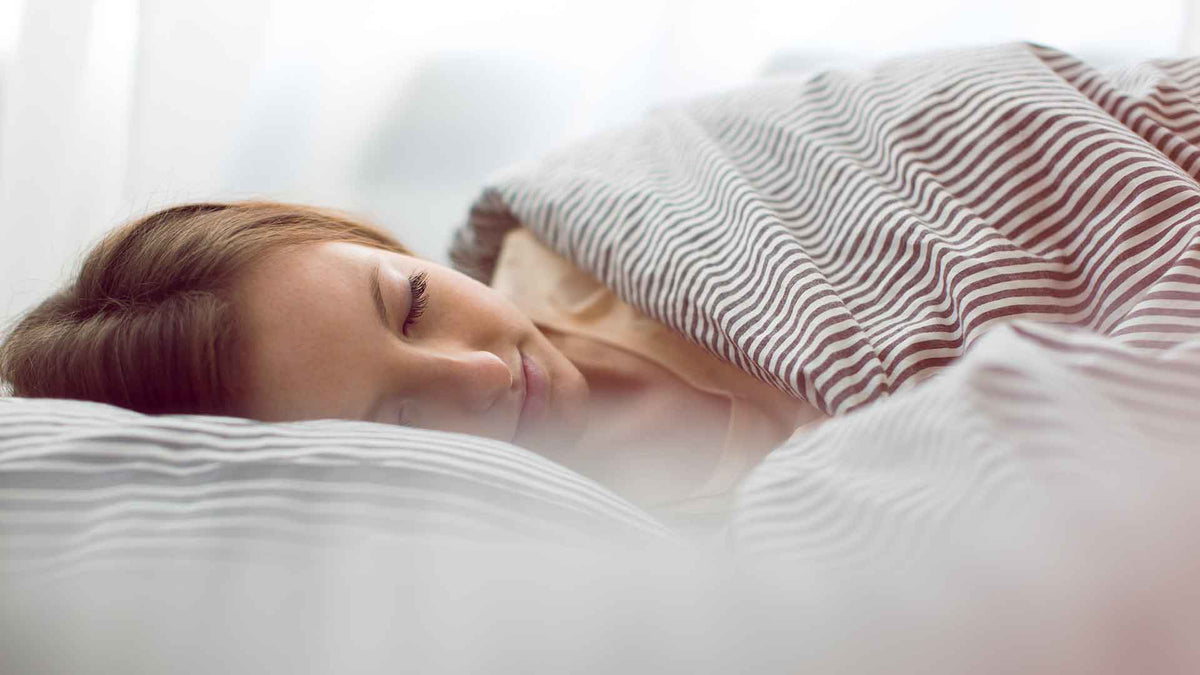
Sleep is health, with good tips for a restful night and natural sleep aids. All this and much more in this exclusive Medicom interview with sleep medicine specialist and television doctor Dr. Michael Feld.
To sleep or not to sleep, sleeping through the night, not sleeping enough... how you sleep is guaranteed to be more than just small talk. The topic of sleep defines us like hardly any other health issue. In the morning, at midday when the energy slump knocks on the door, in the evening—at almost any time of day, we feel in our own bodies whether we have slept well or poorly.
"Sleep is brain detox"
MEDICOM: Why do people sleep poorly? What do you observe in your practice?
Dr. Michael Feld: There are two major themes in sleep medicine. One is falling asleep and staying asleep disorders, which are actually increasing due to the growing pressure, stress, information overload, and scheduling density. The pressure on the night is constantly increasing because there is more and more that can, should, and must be done during the day, and because there is no longer any compulsion to "close your eyes," so to speak. In the evening, the brain is still racing; there is still light, this and that, and that makes winding down difficult for many.
MEDICOM: And we sit too much...
Dr. Michael Feld:... and we don't move enough. And if you think about what percentage of jobs are pure PC workplaces. It's not just that you don't move; all the information goes only into the cerebrum, so both the body and the autonomic nervous system no longer have any tasks at all.
MEDICOM: What happens during sleep?
Dr. Michael Feld: You could say the body needs rest, but the brain needs sleep. This complete loss of consciousness, where the sensory organs go offline—that has to do with the brain. To recover, the brain truly needs what we call sleep, namely a shutting down of consciousness so that everything that went in during the day can be wired together. During sleep, several exciting repair, regeneration, and refreshing processes occur. One example is that there is a kind of brain washing machine at night. You have to imagine that metabolic products and waste products that accumulate through nerve activity cannot be transported away in the brain as well as they can in the calf, for example. In the calf, they move around, and the musculature pumps the interstitial fluid away through movement. But in the brain, there is a bony capsule surrounding it. There is no muscle there to pump the cerebrospinal fluid away. Only during sleep do the cells swell and shrink to pump the fluid away. This is a real cleansing function. If you sleep poorly for decades, there are actual "brain clutter" diseases. It is also assumed that part of Alzheimer's dementia has to do with the fact that the brain washing machine is not working properly at night.
MEDICOM: So "sleeping well" is a good detox cure?
Dr. Michael Feld: Absolutely, sleep is brain detox. And all the systems like the gastrointestinal tract and the cardiovascular system, which are under incredible strain during the day, must be repaired at night because that is when the body is sleeping and resting, and the repair crews can get to work.
Medicom: What are the most common sleep complaints?
Dr. Michael Feld: 30% report at least once in a while that their sleep is not great. One-third have always slept super, one-third are somewhere in between, and one-third have never slept well. Of these, 10% are hard-core insomniacs; in other words, 10% of the population has a truly solid sleep disorder, with slightly more people having trouble staying asleep than falling asleep.
Medicom: Does everyone have their own sleep rhythm?
Dr. Michael Feld: Yes and no. It is true that everyone has a partially individual rhythm, but 70 to 80% of people actually need at least seven hours of sleep. There are few people who are truly healthy and fit long-term on just four to five hours. About 10% need nine to ten hours of sleep. Most people are clocked at seven to eight hours.
Medicom: What general tips do you give to people with sleep problems?
Dr. Michael Feld: There are a few hard rules. The bedroom must be somewhat conducive to sleep. It must be dark enough, quiet, and cool. That means the blinds must be down; you shouldn't use bright light because that disrupts melatonin secretion. It should be quiet and cool because the body can only fall asleep and stay asleep when it cools down.
Furthermore, it is important to exercise as much as possible in the fresh air so that you become properly tired. For people who are sensitive to caffeine, it should be avoided after 3 p.m. because caffeine has a half-life of three to five hours. That means if you drink three cups of coffee at 3 p.m., you still have half of it in your blood at 8 p.m. There are many people whom this doesn't affect. Caffeine-sensitive individuals simply have to be more careful.
Medicom: Let's come to the topic of eating, drinking, and sleeping. Studies prove that alcohol promotes falling asleep but worsens staying asleep. What should I eat or drink, and what not?
Dr. Michael Feld: Alcohol leads to increased muscle relaxation, which in turn can impair breathing and makes sleep shallower at night. Here, the dose makes the poison. And don't eat too fatty, too heavy, or too late, because otherwise, it sits too heavily in the stomach. All the blood goes to the stomach and is not available to the body for sleep. Otherwise, you can eat a diet as rich in tryptophan as possible, as tryptophan is a precursor to the sleep hormone melatonin.
Medicom: What sleep aids are there? Teas, dietary supplements, antidepressants...
Dr. Michael Feld: You can roughly distinguish between non-prescription (i.e., "over-the-counter") and prescription. You can try it yourself for a maximum of four weeks. Herbal remedies are at the forefront: valerian, hops, lemon balm, passionflower. It is actually always best to take a combination preparation where several substances complement each other, because the sum of the substances is more effective than taking a single preparation. If no improvement occurs, you should go to the doctor so that the sleep disorder does not become chronic. They may then prescribe a chemical sleep aid for a while if it comes from a knowledgeable source.
Medicom: What does melatonin do?
Dr. Michael Feld: Melatonin is basically darkness in chemical form. We have to tell the liver, the kidneys, and the other organs indirectly somehow: "Friends, it's dark outside." And that's what melatonin does. Melatonin is a substance that is produced in the small pineal gland in the brain and penetrates all cells in the dark, signaling: "It's dark outside now, time to do repairs, regeneration, etc." Therefore, it is basically not a classic sleep aid, but rather an "inner clock setter for darkness and night."
Medicom: Does taking additional melatonin help if someone has difficulty falling or staying asleep?
Dr. Michael Feld: You can always try it. And in many cases, it has a positive effect. It is relatively effective, especially for women in and around menopause, and for people whose sleep rhythm is always changing, such as those working shifts or where there are strong fluctuations in sleep patterns. They often react quite well to melatonin, whereas for people who have had very intensive sleep disorders for many years, melatonin is often too weak. But you can always try it safely in the first place.
Medicom: Valerian and hops. Why are these the classic sleep aids? How do they work?
Dr. Michael Feld: These plant-based substances also affect neurotransmitters in the brain, though not as strongly as chemicals. Hops act on the GABA system, a brain messenger also stimulated by Valium, as does valerian, among others. It is relatively complex. They have a multifactorial effect. It is better if you take two substances together so that the effect is reinforced. Ultimately, they all act by calming the nervous system.
Medicom: What else impairs our sleep quality?
Dr. Michael Feld: Snoring. Not being able to relax and breathe properly at night is a huge issue. It permanently disrupts the quality of sleep. People are tired, wake up at night without knowing why, get more infections, more allergies, and gain weight. In 40 percent of cases, when you restore breathing—in other words, eliminate the snoring—sleep becomes much better for those people.
Medicom: How does snoring affect the sleep of women and men?
Dr. Michael Feld: Women's sleep is genetically more easily disturbed than men's sleep. This means women are much more quickly disturbed in their sleep by noises than men. However, men snore more frequently. At least from the age of 40, there are significantly more men. Women only follow after menopause. And now they have both in one, so to speak. He snores but doesn't notice it. He is a little tired in the morning. She is constantly waking up at night and feels annoyed. Ultimately, this is also a huge topic for couples.
About the person: Dr. Michael Feld is a television doctor and sleep medicine specialist. He deals with the topic of sleep every day in his practice in Cologne, as well as being a book author. His publications include Beurer Schlafatlas (2017) and Schlafen für Aufgeweckte (2012). MEDICOM interviewed Dr. Michael Feld on the topic of sleep.
Are you interested in melatonin products? You can read more about them here.
Do you want to know more about valerian and hops? You can find out more about them here.