
It's that time of year again... For many, the Advent season and Christmas are the highlight of the year. If you suffer from a food intolerance, however, you should avoid certain treats. Here, you can learn more about intolerances and food allergies, as well as delicious alternatives during the Christmas season.
Gluten, Lactose, Fructose, and Histamine
Especially in winter, people with food intolerances do not have it easy. Most Christmas baked goods, cookies, punch, and mulled wine contain gluten, lactose, fructose, or histamine and are therefore practically inedible for these individuals. Most sparkling wine for New Year's Eve also contains histamine and fructose, not to mention the herring salad, which is absolutely loaded with lactose.
Intolerance or Allergy?
Let's first clarify the terms allergy and intolerance. An allergy is an overreaction of our immune system. Our body does not recognize certain substances (allergens) in food and attempts to fight the "invaders" by producing antibodies.
An intolerance, on the other hand, is a metabolic reaction to specific substances. In this case, the body lacks the enzymes that normally enable it to break down the substances in question from food. As a result, these substances accumulate or are broken down via alternative pathways that put a strain on the organism.
Symptoms of Food Intolerance
It is estimated that a quarter of the European population suffers from an intolerance. The body reacts with a delay and in an individual manner to certain substances in food. Typical symptoms include bloating, nausea, cramps, sweating, itching, rashes, or diarrhea. A food intolerance is not acutely life-threatening to humans.
In Case of Food Intolerance: Making the Right Diagnosis
Stress and an unhealthy lifestyle can also lead to these symptoms. Therefore, it is important to get the right diagnosis when symptoms occur frequently. It takes a lot of intuition and patience to reach a diagnosis. You can imagine the problem that arises when a family member or you yourself suffer from a food allergy or intolerance.
Lactose Intolerance: Goodbye, Dessert?

Lactose intolerance is very likely the best-known food intolerance. People with this condition cannot digest milk sugar. The result: bloating, diarrhea, and general malaise. The enzyme lactase, which is responsible for breaking down milk sugar, is missing. Anyone suffering from lactose intolerance should avoid foods that contain milk sugar, such as milk, cheese, yogurt, or quark. Affected individuals often ask themselves: So, how should I eat now? No more cow's milk ever? You have to find a dietary alternative that does not cause symptoms. Calcium is indispensable for strengthening bone substance and teeth.
As a cow's milk substitute for lactose intolerance, calcium-enriched soy milk or lactose-free dairy products are most suitable. However, since soy milk can lead to allergies and, in people with hay fever, cross-allergies, it is not recommended without reservation. It is also important to be very careful when shopping, as lactose is not only contained in milk but also in many other products, often in sausage and convenience foods, for example, but also in medication!
Tips for Lactose Intolerance
Actually, you can eat everything, but make sure to look for lactose-free products. Products from the MinusL brand, in which the lactose is already in a split form, make your food choices easier. At Christmas, caution is naturally advised with the following lactose sources: sweets, cakes, desserts, bread, and rolls can contain lactose. If you choose vegan Christmas treats or make them yourself, you are definitely on the safe side, because milk is strictly forbidden in vegan recipes.
Fructose Intolerance – When the Fruit Punch Becomes a Fiery Ordeal
This food intolerance is surprising, because eating fruit is healthy. Unfortunately, not for those who suffer from fructose intolerance. Stomach pain, bloating, foul-smelling stools, diarrhea, as well as a feeling of fullness or constipation are no strangers to them.
Fructose Intolerance? Fructose Malabsorption? What Happens to Digestion?
A distinction must be made between congenital hereditary fructose intolerance and the more common and harmless fructose malabsorption (intestinal fructose intolerance), where fructose can only be partially digested.
Intestinal fructose intolerance is more common. What is the cause of intestinal fructose intolerance? Simply put, it is a transport problem. Carbohydrates must be broken down by enzyme activity into simple sugars such as fructose. Afterward, they are transported from the small intestine cells into the blood via transport proteins. With malabsorption (Latin for "poor absorption"), these transport proteins do not function correctly. It is also often due to the fact that there are too few proteins.
This means that a lot of fruit sugar ends up in the large intestine, and that is where the problems begin. More than 20 percent of the population suffers from what is known as fructose malabsorption, the most common form of fruit sugar intolerance.

Self-test for Fructose Intolerance
Do you also have problems more often after consuming fruit, and have you not yet been tested? There is a self-test you can use to roughly estimate whether you might also have intestinal fructose intolerance: Drink 0.5 liters of apple juice. Observe how your body reacts to fructose. If you get diarrhea, a bloated stomach, cramps, and intestinal gurgling, it could be that you have a fructose intolerance. Be sure. A visit to the doctor and a hydrogen breath test will provide more certainty as to whether you are suffering from this food intolerance.
Fructose Intolerance: What You Should Avoid
- Avoid fruit sugar and sorbitol completely. This allows the "distressed" digestive organ to recover and regenerate; symptoms usually subside significantly within two to four weeks.
- Can you consume table sugar with fructose intolerance? Generally, yes. Table sugar does contain fruit sugar (fructose), but it is bound to grape sugar (glucose). This connection ensures that the sugar as a whole can be absorbed and transported much better in the digestive organ.
- In the case of fructose malabsorption: You can partially replace normal sugar with dextrose (grape sugar) and avoid jams or use homemade low-fructose jams. And just like that, the cookies become tolerable. However, be careful with whole-grain flour; it contains more fructose than white flour! When buying all foods, look out for sugar alcohols, especially sorbitol, and avoid dried fruits and raisins!
Because the balance of the intestinal flora is disturbed due to the malabsorption, the organism cannot absorb many vital nutrients in sufficient quantities. Anyone who can eat little to no fruit should ideally ensure a supply of high-quality vital substances, from Vitamin A to Zinc.
Celiac Disease: Keep Your Hands Off Gluten
As a widespread food intolerance, we must also mention celiac disease (non-tropical sprue, gluten-induced enteropathy). Here, the "villain" is gluten. Many people cannot tolerate gluten, the sticky protein found in grains. Typical celiac disease usually develops in infancy but can also occur in adulthood. Symptoms include failure to thrive, bloating, abdominal cramps, fatty stools, and diarrhea.
Where Gluten Is Hidden
Gluten is primarily found in types of grain. These include wheat, rye, barley, or spelt, from which bread, pasta, cookies, and biscuits are made. This can also include baby food or highly processed convenience products. Fruit yogurts, chocolate, sausage products, or pizza dough can also contain gluten – the sticky protein is added during production in the form of flavorings or stabilizers.

Gluten ingested with food reaches the stomach and finally the small intestine. If a person cannot tolerate gluten, the mucosal folds become inflamed, and this leads to a chronic disease of the small intestine. This is accompanied by a regression of the intestinal villi, so that the surface area of the small intestine becomes smaller and the organism absorbs less food.
What is the result? Normally, the intestinal villi filter all important nutrients from the chyme and pass them into the blood. This can no longer happen to a sufficient extent, which leads to malnutrition!
Tips for Celiacs During the Christmas Season
• Almost all cookies are made from wheat flour. But there are also gluten-free alternatives. Try using almond or coconut flour. Vanilla crescents or small amarettini made from almond flour are also gluten-free and easy to make. Recipes and inspiration can be found in large numbers online.
We wish you an enjoyable and relaxed Advent and Christmas season with a "happy tummy"!
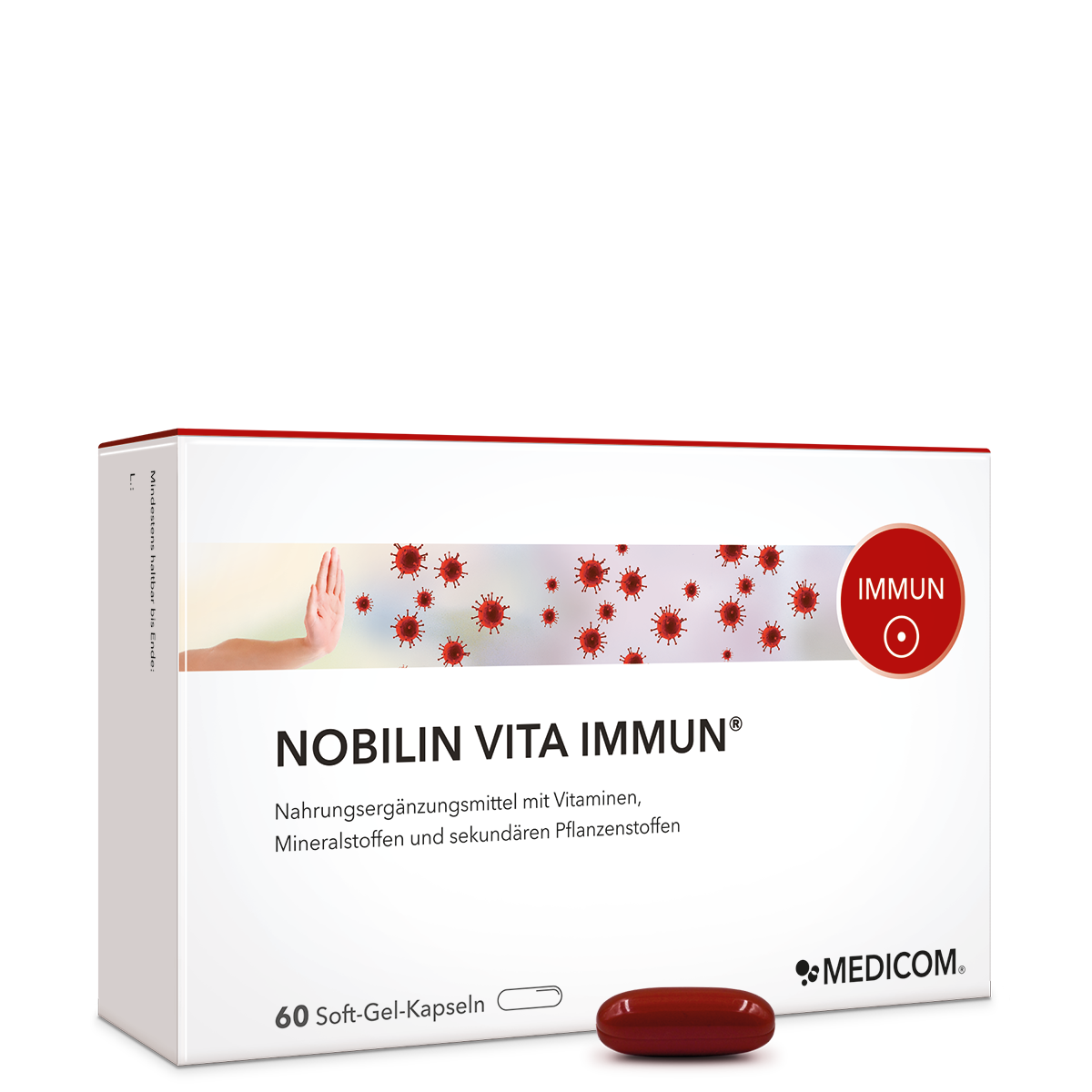
Nobilin Vita Immun®
23 vital substances for a strong immune system