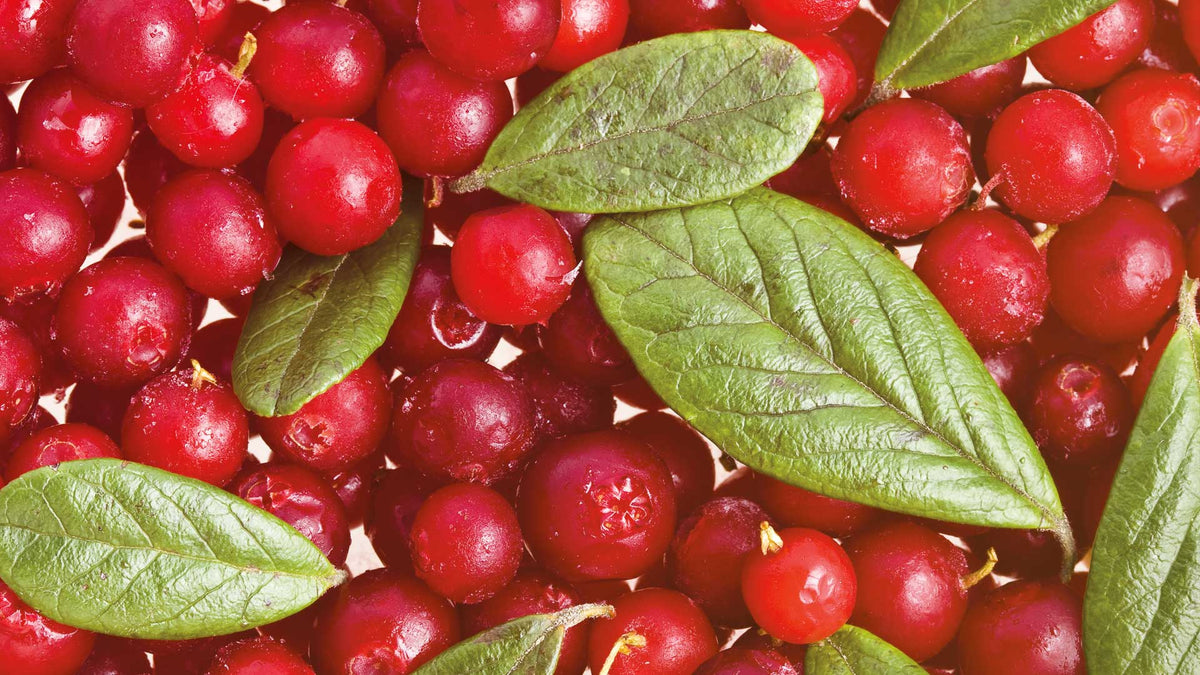
The cranberry (Vaccinium macrocarpon) belongs to the heather family and is also known as the mossberry. For several years, these red fruits have been enjoying a triumphant rise as a superfood.
The term "cranberry" can refer to both the plant as a whole and the individual red berry. The plant is an evergreen dwarf shrub that spreads across the ground with creeping shoots. Since the thin branches grow rapidly and indefinitely, a carpet-like structure forms over time, making it impossible to distinguish individual plants. The leaves have a leathery surface, are 1 to 2 cm long, and taper to a point. Cherry-like fruits containing air pockets develop from the pink-white flowers. They are therefore lighter than water, a fact that is exploited during harvest by flooding the plantations, detaching the berries from the branches, and collecting them as they float on the surface of the water.
Distribution and Use of Cranberries
The cranberry is native to North America. It prefers wet, acidic habitats such as raised bogs, and because of this demanding habitat requirement, it has not spread widely. It can also be found in some German and Dutch moors as well as in England. Large cultivation areas are found in Latvia. The cranberry is popular as a dried snack, in muesli or berry mixes. It is also very suitable for making compote or juice. As a baking ingredient, the cranberry has a more tart flavor than the raisin. Preparations made from the fruits are used not only for their taste but also for their many nutrients and for treating urinary tract infections.
Ingredients and Effects
Cranberries contain anthocyanins, flavonoids, and organic acids, with proanthocyanidins being of particular interest. Thanks to these components, the fruits possess antimicrobial, anti-inflammatory, and antioxidant properties and are used for the prevention or supportive treatment of urinary tract infections, as well as to support healthy bladder function. The proanthocyanidins prevent bacteria from colonizing the urinary tract and help flush them out more easily with urine.
What You Should Consider When Taking Cranberries
For urinary tract infections, you should not only consume cranberries but also ensure you drink plenty of fluids. You should consult your doctor beforehand if you are pregnant, suffer from hypersensitivity, or have kidney or urinary stones. This also applies if you are taking anticoagulants such as Marcumar, as potential interactions may occur.
Would you like to learn more about the cranberry? Then read more here.