Humans are a marvel of mobility. To keep moving smoothly, we need good, strong joints. Anyone who has ever had pain in their knee, hip, or shoulder knows how unpleasant it can be. What are the most common causes of joint pain, and what can we do about it? We will explain it to you.
Joints are involved in all movements in our body. Wherever two bones meet, there are joints of various shapes and sizes. Almost all of us know joint and muscle pain and have experienced it at some point. Straining your back while standing up too quickly, the classic “lumbago,” or twisting a joint while hiking. Pain that temporarily restricts our mobility is very unpleasant and debilitating, but usually goes away on its own.
Joint pain that persists
However, if joint pain restricts our mobility for a longer period, becomes a constant burden, and causes daily pain, our quality of life, our entire body, and our psyche suffer as a result. Sometimes, manifest illnesses are behind it, requiring individual treatment and, in some cases, targeted pain therapy or surgery. Here, we address the most common causes of joint pain and what you need to keep in mind.
What is the function of joints in the body?
Joints connect bones to each other, thereby providing stability and mobility. The articular cartilage acts as a shock absorber. Simply put, joints consist of the joint surface surrounded by cartilage (head and socket), the joint cavity, and the joint capsule, which encloses and stabilizes the joint. The joint head fits into the joint socket like a lock and key. There are also various types of joints, for example, ball-and-socket joints like the hip joint (also known as a nut joint) or hinge joints, like the elbow joint.
Where does joint pain come from?
The causes of joint pain are not always to be found in the joints themselves; the triggers can lie elsewhere. In addition to the skeletal structure, it is primarily the musculature that protects our joints and keeps them pain-free, provided the muscles are trained regularly. Sometimes, muscle pain and pain originating from the joint itself (classic wear and tear) are difficult to distinguish. Shortened muscles can force a joint into an unphysiological position, which can also lead to joint pain and, in the long term, wear and tear.
For persistent joint pain with severe restricted mobility, joint diseases are often responsible. However, other causes such as autoimmune and metabolic diseases, infections, inflammation, and the aforementioned shortened, untrained muscles can trigger joint pain. We want to look into this below.
What are the most common causes of joint pain?
The most common cause of longer-lasting joint pain is wear and tear, followed by joint inflammation.
Arthrosis, arthritis, and rheumatoid arthritis
Most people know wear and tear by the name arthrosis (osteoarthritis), and joint inflammation as arthritis. However, arthritis can also be caused by certain underlying diseases such as rheumatism. This is then referred to as rheumatoid arthritis, an autoimmune disease in which the immune system attacks the body's own cells. This disease can have very painful consequences that severely restrict quality of life.
Ankylosing spondylitis (Morbus Bechterew)
Another common underlying disease that can be responsible for joint pain is ankylosing spondylitis (also known as Bechterew's disease). It is a chronic inflammatory disease of the spine that is also classified as an autoimmune disease. With this disease, patients develop increasing ossification of the entire spine and severe pain in later stages. In particular, the spine and the sacroiliac joints in the pelvic area are inflamed in ankylosing spondylitis. It often occurs in flare-ups.
Gout
Another common cause of joint pain is gout. This is a metabolic disease associated with an increased uric acid concentration in the blood, where joints can become severely inflamed because uric acid crystals are deposited in them. An attack of this disease is considered extremely painful. Here, too, the cause lies not in the joint itself, but in the fact that the body cannot break down the uric acid in the blood, causing it to deposit in joints, bursae, and tendons.
The mentioned diseases are only a selection of reasons that frequently cause joint pain. There are many other possibilities and diseases that can be responsible for the development of joint pain. In a new article series following this lead article, we want to address the most common causes of joint pain and explain five of the most important causative diseases.
Common causes of joint pain are:
- Wear and tear and inflammatory changes, i.e., arthrosis and arthritis
- Autoimmune diseases such as rheumatoid arthritis and ankylosing spondylitis
- Metabolic diseases such as gout
How can joint pain manifest?
Joint pain can manifest in one joint or in several joints simultaneously. It can have a different pain character.
Typical characteristics of joint pain include pain:
- that improves with movement (for example, typical starting pain in the morning, so-called morning stiffness. Common causes here are arthrosis)
- that occurs primarily when lying down, at night, and at rest (for example, ankylosing spondylitis)
- that worsens with any form of movement and exertion (typical for acute inflammation or severe degenerative changes, for example, advanced hip arthrosis)
- like with acute inflammation, with warmth, swelling, and redness around the joint. Movement is very painful; one wants to cool and rest the joint.
What role do the muscles play in joint pain?
It is important not to equate muscular tension caused by, for example, shortened muscles or adhered fascia (this is the thin, tendon-like "skin" that covers the muscle and often connects large areas in the body) with a joint disease, although in the long term, the joint can also be damaged here by unphysiological stress (e.g., constant tension).
When should you see a specialist?
To distinguish between these, you should always consult a doctor if you have persistent pain. If the cause of pain is unknown, the symptoms do not go away on their own, or they seem to originate from a joint, the spine or vertebral joints, or several unrelated joints—in these cases, you should see a specialist. After a thorough examination, they will make a diagnosis and show you options for action.
For predominantly muscular complaints, for example, mild back problems due to lack of exercise, pain when standing up, after sitting for a long time, or other non-acute pain, an osteopath is an alternative alongside a physiotherapist. They attempt to restore the entire body's individual balance holistically and gently through its joint, muscle, and organ systems, which often helps to alleviate pain.
The mechanism applied here is the "promotion of self-healing powers" and showing the body the path toward them. Many statutory health insurance funds cover a portion of the costs for certified osteopaths. Simply ask your health insurance provider.
However, if joint pain occurs acutely and suddenly, and swelling, redness, or warmth of the joint can be seen, you should contact a doctor immediately in any case, as this could be an infection or acute joint inflammation that must be treated medically as soon as possible.
What can I do myself?
"If you rest, you rust" is an old saying, and there is some truth to it. Especially with joint pain caused by muscular tension, but also with incipient or known wear and tear, one should almost always "move more" after therapeutic advice. Exceptions are acute inflammation or, for example, an acute gout attack. However, it is a common misconception that "lumbago"—which is classically triggered not by the vertebral joint but by shortened muscles—disappears faster if you stay in bed. If, however, numbness occurs in certain parts of the body, especially the legs, a doctor must be notified immediately, as this could be a herniated disc.
Movement and physiotherapy
Light movement, sports such as swimming or gymnastics, and targeted stretching exercises can be surprisingly helpful, especially when it is not the joints themselves but the muscles around them that are the cause of the joint pain. Often, a physiotherapist can show you targeted exercises that you can also perform at home.
Anti-inflammatory diet
If the cause of the symptoms lies in the joint itself, one should also review their diet. For degenerative joint diseases, i.e., signs of wear and tear of the cartilage (arthrosis), one should switch to an "anti-inflammatory diet," meaning less meat, more alkaline foods like fruits and vegetables, as well as whole foods, and reduce weight. Every extra kilo can increase pain in patients with arthrosis, for example. Conversely, weight loss combined with moderate exercise and a healthy diet can have a positive effect. Patients with arthrosis or arthritis should strongly reduce or, ideally, avoid pork with its high proportion of pro-inflammatory arachidonic acid.
A good fatty acid distribution in the diet with plenty of high-quality omega-3 fatty acids is recommended, which can be found, for example, in linseed oil, hemp oil, and fish. The ratio of omega-6 to omega-3 fatty acids should be 6 to 1; for joint diseases with inflammatory components, 2 to 1 is better. One should also ensure a good supply of vitamin E, primarily in high-quality vegetable oils, as a good supply can have a positive effect on chronic inflammatory processes.
What does the doctor do?
Do not try to find the cause yourself if you have persistent joint pain; in any case of long-term pain or joint problems that occur in flare-ups, you should consult a doctor. Rarely, organic causes can also play a role in joint pain.
To rule out, for example, autoimmune diseases, metabolic diseases, but also diseases of the organ systems such as inflammation and tumors as a rare cause of joint pain, the doctor will interview and examine you extensively and, if necessary, refer you to a specialist.
This includes specific movement tests, blood parameters, and, in cases of doubt, imaging procedures such as X-rays, MRI, or CT. Therapeutically, short-term pain relievers and anti-inflammatory substances (e.g., diclofenac, cortisone, muscle relaxants), physiotherapy, and, in certain cases, surgeries are used.
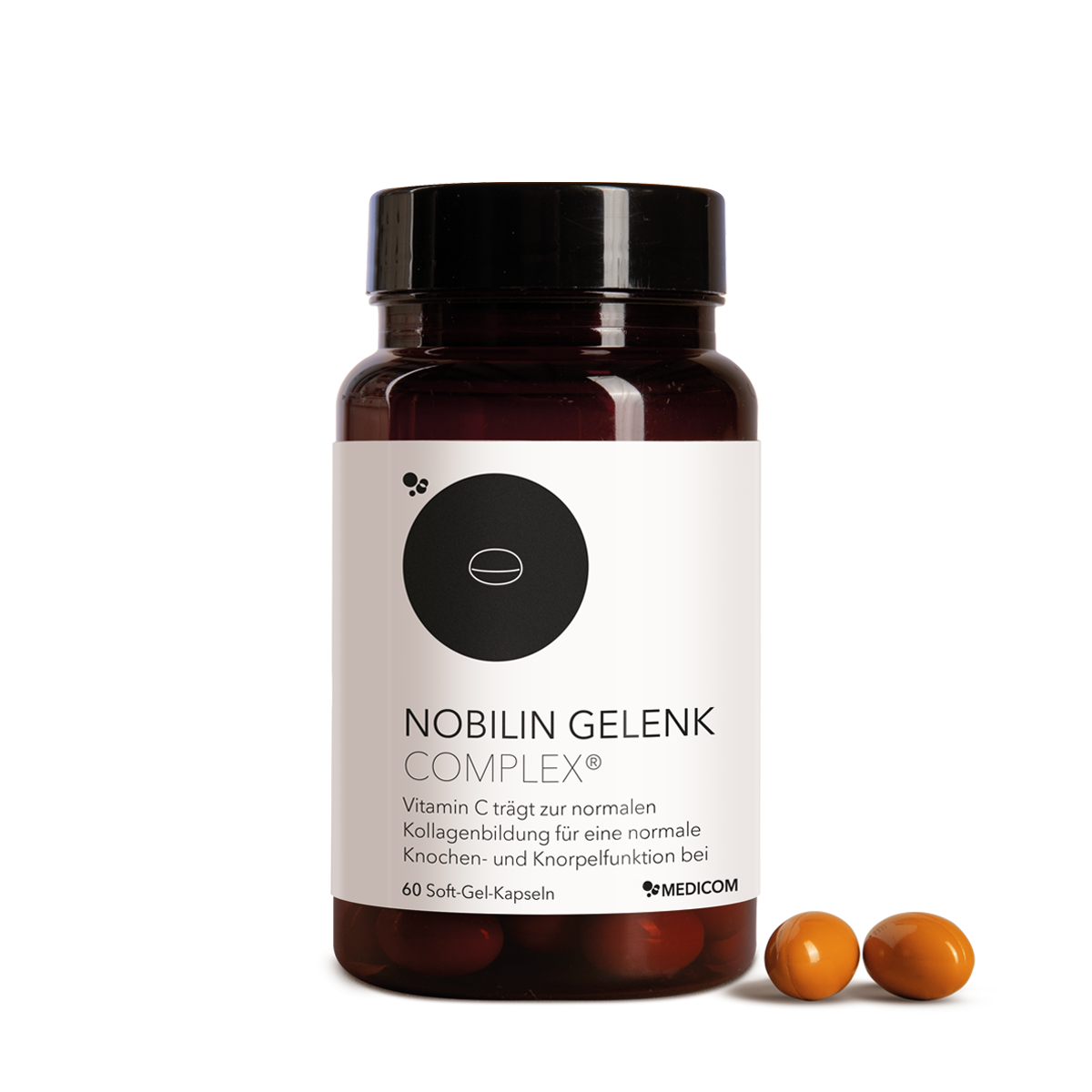
Nobilin Joint Complex®
With curcumin extract, frankincense and hemp oil
Which gentle methods and movement therapies can positively influence joint pain?
There is a wide range of options from natural medicine and holistic medicine, some of which have not been definitively scientifically proven, but with which many people with joint complaints have had positive experiences. It is important to see a doctor beforehand, because not every holistic method is suitable for every cause of joint pain and cannot replace medically necessary therapy.
Contraindications as well as interactions with allopathic medications are also possible. Examples: You cannot "naturally" heal a broken leg or a completely worn-out hip joint. However, holistic procedures can make sense, for example, after a necessary operation to accelerate the healing process and regain strength more quickly. Therefore, holistic or naturopathic therapy should not replace conventional medicine, but meaningfully complement it, so that, for example, fewer painkillers might be necessary and quality of life improves more quickly.
Depending on the disease, the following holistic procedures may be considered, also in combination:
-
Acupuncture: Traditional Chinese therapy with thin needles that are placed at specific points according to the teachings of TCM (Traditional Chinese Medicine) to restore or balance the meridians (energy channels in the body). The method is largely recognized in conventional medicine.
-
Massages: Various types such as acupuncture massage, where specific acupuncture points are stimulated according to TCM, or classical massages to loosen the muscles, as well as massages with essential oils to achieve deep relaxation.
-
Osteopathy: A form of therapy in which the therapist attempts to restore the muscular, skeletal, organ, and craniosacral systems to their physiological balance through gentle touch, specific manipulations, and techniques, thereby promoting the body's self-healing powers.
-
Micronutrient medicine with anti-inflammatory substances: Through high-dose therapy with specific micronutrients, such as plant enzymes, essential fatty acids, and vitamins such as vitamin E—which in studies was shown to have properties similar to anti-inflammatory painkillers in certain dosages and for certain diseases—oxidative processes in the body are to be regulated and inflammation inhibited. This therapy should only be carried out under therapeutic supervision and expert advice. Interactions with medications are possible.
-
Phytotherapy (herbal medicine): Uses specific medicinal plants which, when expertly selected, can be used for joint complaints to alleviate pain and restricted mobility. These include, for example, medicinal plants such as Indian frankincense (Boswellia serrata) used in Indian medicine. For the latter, the available studies are not yet sufficient to approve frankincense as a herbal medicinal product. It is therefore currently only available in Germany as a dietary supplement, but has a high status in Indian medicine.
- Homeopathy: A scientifically unrecognized method in which a highly diluted substance (from plants, minerals, or organs) is produced through a targeted and individual selection of remedies, which is also intended to strengthen the body's self-healing powers. For example, "Arnica globules" can be found in many home medicine cabinets for minor injuries or mild joint complaints. Despite the lack of scientific recognition, homeopathy enjoys increasing popularity.
Conclusion
Joint pain can have a wide variety of causes. Wear and tear, chronic and acute inflammation, hardened or shortened muscles due to lack of movement or repetitive strain, and autoimmune and metabolic diseases are common reasons why we may suffer from painful mobility restrictions. In a new series, we therefore want to address five diseases that are particularly frequent causes of joint pain.
Are you interested in the connection between joints and nutrition? Then we recommend reading: Joint-healthy nutrition? Here is how.