Even though "fat" often has a bad reputation regarding our diet, it is, alongside carbohydrates and proteins, a potent and vital source of energy. This article covers the most important facts about fatty acids in our diet. After all, not all fats are the same.
What are fatty acids?
The most important building blocks of fats are fatty acids. Fatty acids are distinguished based on their different chemical structures. Decisive factors include, for example, chain length, i.e., short-chain/long-chain fatty acids, the degree of saturation, i.e., saturated or unsaturated fatty acids, and whether the fatty acid is vital or essential for the organism. Essential means that the fatty acid cannot be produced by the body itself.
Fat is needed, for example, to absorb fat-soluble vitamins A, D, E, and K, but also for building body cells and messenger substances. However, not all fat is the same, and there are important distinguishing features, especially regarding our health. A distinction is mainly made between three different fatty acids:
- Saturated fatty acids are found primarily in animal products, e.g., butter, cream, lard, meat, and sausage products. However, they are also present in plant-based foods such as palm and coconut oil. Saturated fats are not essential and can have an unfavorable effect on blood lipid levels and should therefore only be consumed in moderation. The rule of thumb is: the firmer a fat is, the more saturated fatty acids it contains, see e.g., butter, coconut oil, lard.
- Monounsaturated fatty acids are found predominantly in plant-based foods. These include vegetable oils as well as nuts, olives, avocados, and seeds. They are considered health-promoting and can have a positive effect on blood lipid levels. However, they are not essential. Omega-9 fatty acids, which are found in many of the aforementioned foods, are also monounsaturated fatty acids. One should not be confused here, because despite the "Omega" in the name, this fatty acid is not essential, yet it has the health-promoting effects of a monounsaturated fatty acid.
- Polyunsaturated fatty acids are essential and must therefore be supplied through the diet. Well-known representatives are the omega-3 and omega-6 fatty acids, whose health benefits we report on in this article.
What are essential fatty acids?
Certain fatty acids are indispensable for the human body. The body cannot produce these compounds itself. We are referring to the essential or polyunsaturated fatty acids.
Basically, fatty acids can be produced by the body itself. However, there are important exceptions. These include polyunsaturated fatty acids such as omega-3 and omega-6 fatty acids. Polyunsaturated fatty acids differ from other fatty acids in their chemical structure or composition. As the name suggests, polyunsaturated fatty acids have multiple double bonds between their carbon atoms (C-atoms) in their fatty acid chain compared to other fatty acids.
Which are the most important omega-3 fatty acids?
- Alpha-linolenic acid: Found, for example, in linseed oil, nuts, wheat germ, and soybeans.
- Eicosapentaenoic acid (EPA): Found in fatty fish (cold water) such as mackerel or eel, but also in Antarctic krill as well as in algae.
- Docosahexaenoic acid (DHA): Found, like EPA, especially in certain types of fish.
The latter two fatty acids (EPA/DHA) can be partially produced from alpha-linolenic acid.

Which omega-6 fatty acids are among the most important?
- Linoleic acid: Found primarily in vegetable oils such as sunflower oil, black cumin oil, or corn oil, and also in fatty sausage and meat. Conjugated linoleic acid (CLA), which differs slightly chemically, can be found, for example, in meat, milk, and dairy products from ruminants.
- Gamma-linolenic acid: Found in proportion in evening primrose oil, borage seed oil, black cumin oil, hemp oil, and pomegranate seeds. It can be produced from linoleic acid and, compared to arachidonic acid, has, among other things, anti-inflammatory and blood pressure-regulating properties. It plays a role in a strong skin barrier and can have positive properties, e.g., promoting wound healing and regulating skin health.
- Arachidonic acid: Found in proportion in animal foods such as pork, lard, bacon, eggs, and also butter. Since its metabolism produces degradation products or tissue hormones that can promote inflammation in the body, these should only be consumed in very small quantities, if at all, especially if one suffers from gout, rheumatism, or other chronic inflammatory diseases. The requirement can easily be balanced by other omega-6 fatty acids. Foods with a high proportion of gamma-linolenic acid are particularly recommended.
Gamma-linolenic acid and arachidonic acid can basically be produced from linoleic acid.
Good to know: In people with inflammatory diseases of the musculoskeletal system, e.g., rheumatism or osteoarthritis, a high intake of arachidonic acid-containing foods is viewed negatively, as this can promote inflammation in the body.
What do essential fatty acids serve for?
Essential fatty acids are excellent sources of energy; however, regardless of this, they are also involved in the construction of cell membranes and provide them with stabilizing protection. Furthermore, they serve to build important tissue hormones. Eicosanoids belong to the tissue hormones. They are involved in many physiological processes in the body, e.g., inflammation regulation, vascular function, and blood clotting.
Eicosanoids include various hormone-like messenger substances such as prostaglandins or leukotrienes. They have various regulatory tasks in the body and, depending on the type, can have, for example, anti-inflammatory or pro-inflammatory properties.
Therefore, it is very important that the ratio between both essential fatty acids in the diet is correct, because a strong oversupply, especially of the omega-6 fatty acid arachidonic acid, can result in negative effects regarding inflammatory processes, blood clotting, or vascular health. Unfortunately, the ratio between omega-3 and omega-6 fatty acids in the Western diet is not always positive.
What is the right ratio between omega-3 and omega-6 fatty acids?
As with many other bodily processes, the right ratio is also essential when it comes to essential fatty acids. While our diet provides us with omega-6 fatty acids relatively well, we struggle, above all, with the important omega-3 fatty acids. Especially with the two demonstrably health-promoting omega-3 fatty acids, EPA and DHA.
As described above, these occur primarily in fatty cold-water fish and can only be produced to a limited extent from alpha-linolenic acid. The best sources for EPA and DHA are certain fish products and seafood, e.g., krill oil as well as algae.
Fatty sea fish are nowadays rarely on the weekly menu. This can have a negative impact on the correct balance of the two fatty acids. According to the German Nutrition Society (DGE), the ratio of omega-6 to omega-3 fatty acids should be a maximum of 5:1. In fact, the proportion of omega-6 fatty acids is often significantly higher, to the detriment of omega-3 fatty acids. This can have negative health consequences.
Why are essential fatty acids good for health?
Particularly health-promoting properties are proven today, with targeted additional intake, especially for omega-3 fatty acids. It should not be forgotten that we still need the equally essential omega-6 fatty acids in our diet because they are also involved in many regulatory tasks in the organism.
However, the coverage of omega-6 fatty acids is usually sufficiently guaranteed through a normal diet. An exception is certain enzyme defects where, for example, the conversion of linoleic acid into the important gamma-linolenic acid does not work. This can play a role in certain skin diseases such as neurodermatitis and psoriasis (psoriasis).
While alpha-linolenic acid, as an omega-3 fatty acid, can have a positive effect on cholesterol levels, EPA and DHA, which are rarely covered by diet, have further health-promoting properties.
For example, EPA is involved in healthy heart and vascular function. This can have a positive effect on blood pressure and arterial health, among other things. Furthermore, EPA contributes to a normalization of triglyceride concentration (neutral fats) in the blood.
DHA, in turn, has particularly favorable properties for brain function and can be positive for maintaining eyesight.
As already stated, omega-3 fatty acids are frequently in short supply in our diet today. Especially if fatty fish is not consumed regularly, i.e., at least once or twice a week, it can be health-wise sensible to supplement with omega-3 fatty acids. This refers primarily to the two particularly relevant fatty acids, EPA and DHA. This can be done via certain omega-3 fish oil products, krill oil, or, for vegetarians or vegans, via selected algae oil products. It is important to pay attention to a relevant proportion of EPA and DHA.
What is special about omega-3 from krill oil?
Omega-3 fatty acids occur in various forms and in various foods. A particularly interesting source is krill oil. Antarctic krill is a type of crustacean native to the waters around Antarctica. We remember that the two particularly health-promoting fatty acids EPA and DHA occur primarily in cold-water fish. These small crustaceans feed on particularly pure phytoplankton. They are therefore less burdened with pollutants because they are at the very beginning of the food chain. However, krill oil has some other special features as a high-quality source of omega-3 fatty acids.
- Krill oil is bound to important phospholipids. These have diverse functions in the body; among other things, they are a component of the cell membrane and protect it. They are involved in cell metabolism and ensure, on the one hand, good permeability for required substances and, on the other hand, rapid transport of used substances. Furthermore, phospholipids are said to increase the bioavailability of the valuable fatty acids EPA and DHA.
- Krill oil also contains the highly antioxidant astaxanthin. It belongs to the carotenoids and occurs in microalgae, which the krill feeds on. Antioxidants offer protection against "free radicals," which the body forms itself during various metabolic processes. However, if the body's own antioxidant systems are overloaded, these radical oxygen compounds can damage the cells. Reasons for such an overload can be, for example, stress, environmental toxins, UV radiation, and a diet low in vitamins and vital nutrients.
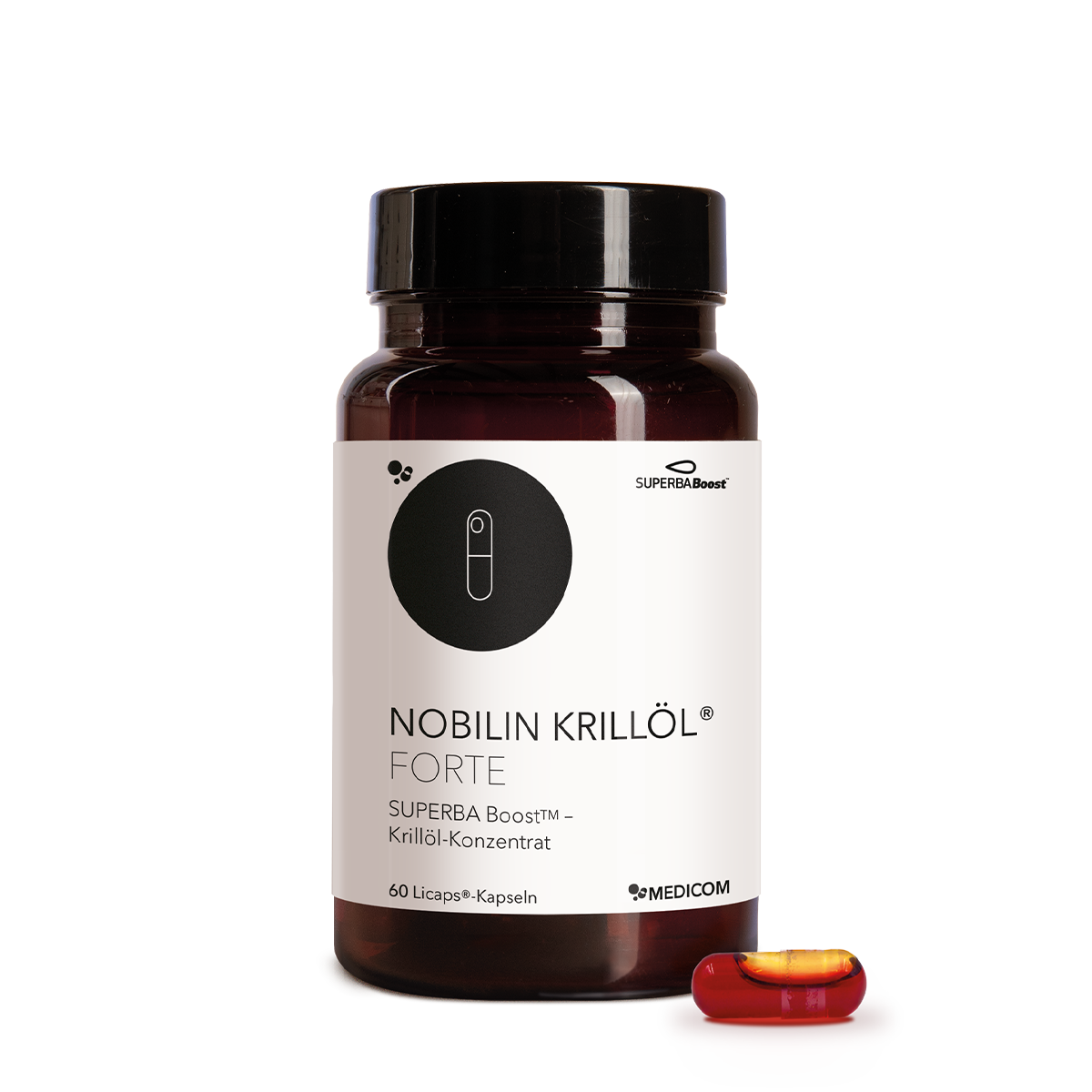
Nobilin Krill Oil® Forte
The best source of omega-3 in capsule form
Conclusion
Polyunsaturated omega-3 and omega-6 fatty acids are both vital components of our diet. However, it is of great importance that these fatty acids are supplied in the right ratio. A poor ratio of omega-3 to omega-6 fatty acids, especially arachidonic acid, which is contained in many animal products, can have negative consequences for our health. The ratio of omega-3 to omega-6 fatty acids in the Western diet is often unfavorable. This means an excessively high proportion of omega-6 fatty acids compared to omega-3 fatty acids.
Omega-3 fatty acids, especially the important representatives eicosapentaenoic acid (EPA) and docosahexaenoic acid (DHA), which are found primarily in fatty sea fish, are considered beneficial for heart and vascular health and have positive effects on normal brain function.
Omega-3 fatty acids from Antarctic krill oil have particularly positive properties. These additionally contain vital phospholipids as well as the strong antioxidant "astaxanthin." If omega-3 fatty acids are in short supply in the diet, e.g., because fatty sea fish is not eaten or eaten too rarely, the additional intake of products with omega-3 fatty acids can make sense. In case of known blood clotting disorders or the intake of medications that reduce blood clotting, one should always consult a doctor before taking them.
• Would you like information on omega-3 products? You can find more here.