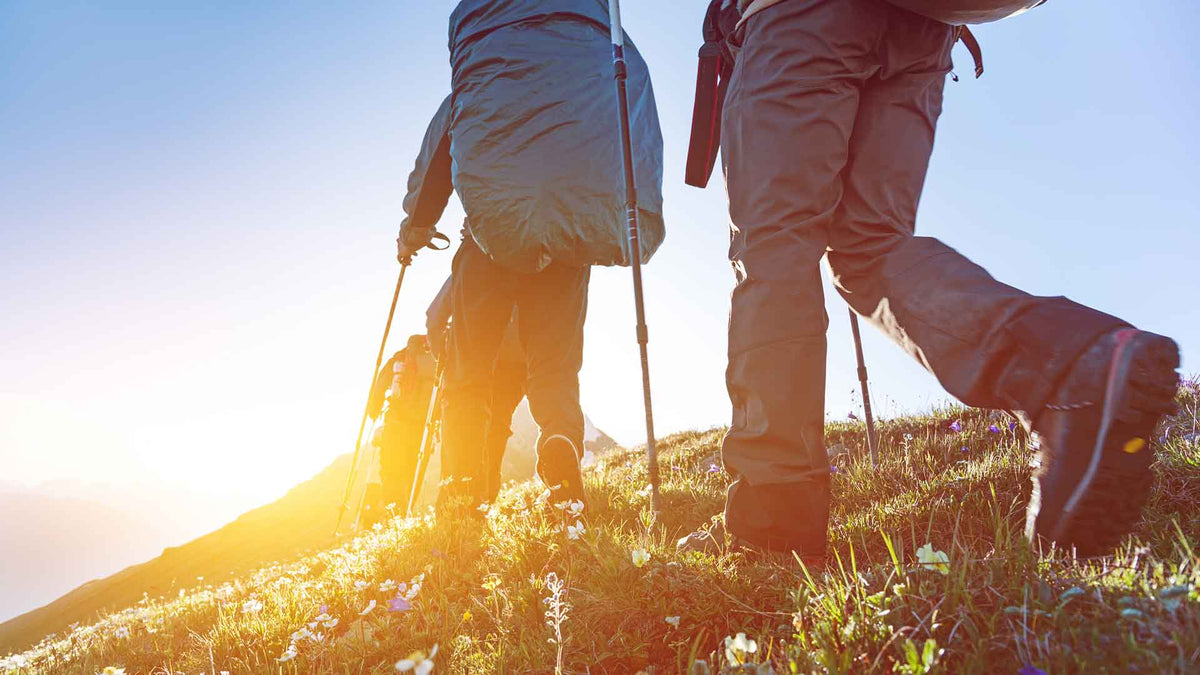
Medicom meets hiking guide and author Steve Keller for an interview on Mallorca, one of Europe's great hiking paradises. From a stuffy sport for seniors to a trendy activity for young people, hiking is experiencing a renaissance. In this interview, Steve Keller explains why hiking fascinates him.

In less technical terms, I would say it is the perfect melange of exertion and recovery. It feels like recovery, but it’s amusingly strenuous. Furthermore, hiking provides room for contemplation. Be it outwardly, to connect with nature, with the smells and moods of the landscape, or inwardly, to yourself.
Medicom: What do you mean by that? Steve Keller: Through countless repetitions of the same process, namely a step, a kind of serenity emerges where only the next step counts, nothing else. And this certainty seems to open up an internal space, a kind of soothing emptiness – not unlike breath meditation. I can't describe it any better.
Medicom: Hiking has become really modern again. How can this trend be explained? Steve Keller: Yes, that's true. Hiking has experienced a real renaissance in recent years. From its slightly stuffy image as a sport only for seniors, it has become a hip outdoor experience, especially for younger people. That certainly has something to do with the simplicity of hiking. A pair of sturdy shoes, a bottle of water, and you can master small tours. In a very complicated, extremely fast-paced world full of technical devices, hiking acts as a gentle counter-proposal toward intentional deceleration. Everything moves slowly. We humans seem to need that more than we’d like to admit. This slowness is what makes the longed-for nature experience possible in the first place. A certain buried romanticism also plays a role here.
Medicom: And yet, there is a big industry behind the new hiking romanticism. Steve Keller: That’s true. It’s incredible how it has developed. But that has, of course, led to young people and families suddenly going hiking. Functional clothing is becoming increasingly stylish, so you can look really sharp while hiking. And the incredibly well-designed baby and child carriers allow young families to hike, too. In my childhood, there was no such practical gear. Despite all the commercialism, this development has something positive to it, as it brings people to hiking who would certainly have refused before. However, I think we Germans focus a bit too much on equipment. Sometimes I have people in my groups who are equipped for a hike with 300 meters of altitude as if they were going to climb Mount Everest. The magic of hiking lies in the fact that you barely need anything at all.
Medicom: What, in your opinion, are the most important things you should have with you? Steve Keller: A fully charged mobile phone is very important, of course. Not to upload pictures, but to make an emergency call in case of an emergency. Add to that maps if you are hiking without a guide. Then water. You should have about 1.5 liters per person. Even more in high temperatures. Then, of course, the shoes should be of decent quality. Warm, dry clothing should always be with you, even if it is already very warm. At higher altitudes, it gets colder quickly. The temperature drops by about 1°C per 100 meters of altitude. Weather and wind changes occur every minute in the mountains. And anyone who has ever rested at high altitude while sweaty knows how quickly you cool down. If you still have room in your backpack, you should think about provisions, a first-aid kit, and sunscreen.

Medicom: How can you get hiking grumblers to finally set off? Steve Keller: In any case, start by choosing small, flat hikes. This way you quickly have a sense of achievement and get a taste for it. It is also helpful to walk in a larger group. The atmosphere is usually good. There is interesting conversation along the way, and having a picnic together is more fun than alone. At the beginning, it makes sense to set a viewpoint, a mountain hut, or a specific natural monument as a goal. For those who haven't fully internalized the idea that "the journey is the reward," such a highlight is simply more motivating. This could certainly be a restaurant where you reward yourself with a healthy snack.
Medicom: Speaking of snacks. What should one keep in mind regarding nutrition? Steve Keller: Well, you should have a good and balanced breakfast before hiking. For on the go, fresh fruit or energy bars with cereals are usually enough. When stopping for a break, I wouldn’t eat anything too fatty, as you will feel it later on the trail. Alcohol should also be avoided, as it reduces concentration and makes you more likely to trip or slip. What is very important is magnesium. Especially for hikers over 40.
Medicom: What makes magnesium so valuable when hiking? Steve Keller: After a long hike with many meters of altitude, the leg muscles shorten noticeably. In case of doubt, you only feel this in the evening or in bed. Very unpleasant cramps can be the result, and you rob yourself of the well-deserved night's rest, which is usually heavenly after hiking. It is therefore advisable to take magnesium before or immediately after the hike and possibly do a few stretching exercises. Then you will be in top shape the next morning. The magnesium nourishes and relaxes the stressed muscles. I take magnesium myself and always have some for my clients. They can be taken immediately, without any water.
About the person: Steve Keller is an author, musician, and passionate hiking guide in the Balearic Islands. He knows the Tramuntana mountains on Mallorca like the back of his hand. His publications include "Wanderspaß mit Kindern. Mallorca: 22 erlebnisreiche Touren" (Hiking Fun with Children. Mallorca: 22 Eventful Tours), 2016, Bruckmann Verlag.
• Would you like to know which health products can support you while hiking? Find out more here.