In this post, we want to address one of the most common reasons for joint pain: osteoarthritis – it is by far the most frequent cause of joint pain and, unfortunately, can be found in some form in almost everyone as they age.
What is osteoarthritis actually?
Osteoarthritis is the most common joint disease. It refers to the wear and tear of the cartilage in one or more joints. The joint cartilage acts as a type of protective layer located between two bone ends. The job of the joint cartilage is to prevent "bone on bone" friction. In doing so, the cartilage functions like a type of "shock absorber" designed to distribute the load evenly across the entire joint.
Due to advancing age and the associated physiological wear and tear, but also due to constant improper loading or overloading, the joint cartilage can be damaged. We then speak of osteoarthritis, the classic form of joint wear, which is classified as a degenerative joint disease. From the standpoint of conventional medicine, osteoarthritis is not curable.
In the late stage, the diseased joint can only be replaced by an artificial one. However, there are many stages prior to this that can certainly be positively influenced through a healthy lifestyle.
Which joints are affected by osteoarthritis?
As a rule, these are the joints that are subjected to particular strain, such as the knee or hip joint.
Based on the joints affected, the following types of osteoarthritis are essentially distinguished:
- Knee osteoarthritis (gonarthrosis)
- Hip osteoarthritis (coxarthrosis)
- Ankle osteoarthritis
- Finger osteoarthritis
- Thumb joint osteoarthritis (rhizarthrosis)
- Big toe osteoarthritis
- Spondylarthrosis: osteoarthritis of the spinal joints
- Omarthrosis: osteoarthritis of the shoulder joint
How does osteoarthritis manifest itself?
Increasing joint pain is typical. In early stages, this only occurs during physical exertion. Only in an advanced stage does it occur during normal activity. In the final stage of the disease, however, pain occurs even at rest and is then considered so distressing that surgery becomes unavoidable in many cases.
In this context, the pain symptoms expected based on medical imaging can differ significantly from the pain subjectively felt by the patient. There may already be clearly visible changes to the joint cartilage, yet the patient does not necessarily have to be in pain.
Classic symptoms of osteoarthritis are:
- Pain during movement and exertion
- Typical "start-up" pain (e.g., morning pain after getting up, which improves with increased movement)
- Restricted joint mobility
- Possible visible swelling of the joint
- Possible increase in joint circumference (thickening around the joint, potential loss of strength)
What are the risk factors for osteoarthritis?
There are typical risk factors that make the development of osteoarthritis more likely, even at a younger age.
The most important factors are:
- Obesity
- Gender – women are affected somewhat more frequently
- Years of athletic overloading, especially in youth
- Misalignments
- Trauma with cartilage injury, for example, from a sports accident
- Predisposition, i.e., if one or more family members suffer from osteoarthritis
- Injuries that have not healed properly, for example, if the joint was put under strain too soon after an injury.
How is osteoarthritis treated?
Conservative methods are primarily aimed at the pain that osteoarthritis patients frequently experience. Initially, a multitude of non-surgical measures are generally considered. For example, if a patient is overweight, a doctor will urgently advise weight loss, as every extra kilo puts strain on the joint and exacerbates the situation.
Exercise for osteoarthritis
More movement, such as a daily walk and joint-friendly sports, also count as conservative advice. Gentle sports include swimming, gentle walking, or gymnastics and targeted muscle-stretching exercises. Often, due to non-physiological loading caused by compensatory posture, the muscles also become involved. These shortened or tense muscles around the joint can contribute significantly to the development of pain.
The doctor usually also prescribes physiotherapy or remedial gymnastics. With this manual movement therapy, you will often receive exercises to do at home in addition to targeted treatment. Physical therapies such as heat or cold applications can also alleviate pain and may be performed upon medical instruction.
Painkillers are only used when the symptoms and pain impair the patient to the point where they become a burden. Unfortunately, these often have serious side effects, especially with long-term use, and should be carefully weighed with a doctor. Treatments include anti-inflammatory drugs such as non-steroidal anti-inflammatory drugs (NSAIDs) or cortisone preparations.
In any case, other therapy options should have been exhausted before regularly taking medications such as those mentioned. Direct injections into the joint are also possible. An exception is if the joint is already so damaged that other therapy no longer seems promising.
At the end of an often long-standing osteoarthritis process, there is usually joint replacement and thus surgery. Often, this is the more sensible solution compared to years of taking painkillers. Contact a specialized center, because the more frequently a specific joint replacement is performed, the better the subsequent results. However, before reaching this point, personal initiative, gentle procedures, and the use of natural medicine can certainly delay the pain process.
What can you do yourself?
As a rule, you can contribute three essential things yourself:
- weight reduction if you are overweight
- switching to a healthy, low-inflammation diet (high proportion of omega-3 fatty acids and gamma-linolenic acid, for example, in borage or evening primrose oil), a base-rich diet, meaning plenty of fruit and vegetables and thus a high proportion of natural antioxidants). Arachidonic acid, which is found primarily in animal products such as pork or bacon and can be involved in pain development through messengers, should be reduced.
- regular exercise and joint-friendly sports
What alternative therapies are there for osteoarthritis?
In addition, nutritional and alternative medical approaches can be considered to complement conventional medical therapy. This includes, for example, acupuncture, which is part of TCM. This is a therapy that can contribute to pain relief through targeted needles placed on the meridians, i.e., the energy channels according to Chinese teaching. This method is largely recognized by conventional medicine as well.
Frankincense and Turmeric
Herbal medicine (phytotherapy) can also be helpful. Certain plant ingredients possess anti-inflammatory properties for joint complaints. Traditional medicinal plants such as Indian frankincense (Boswellia serrata) and turmeric show positive effects on joint health.
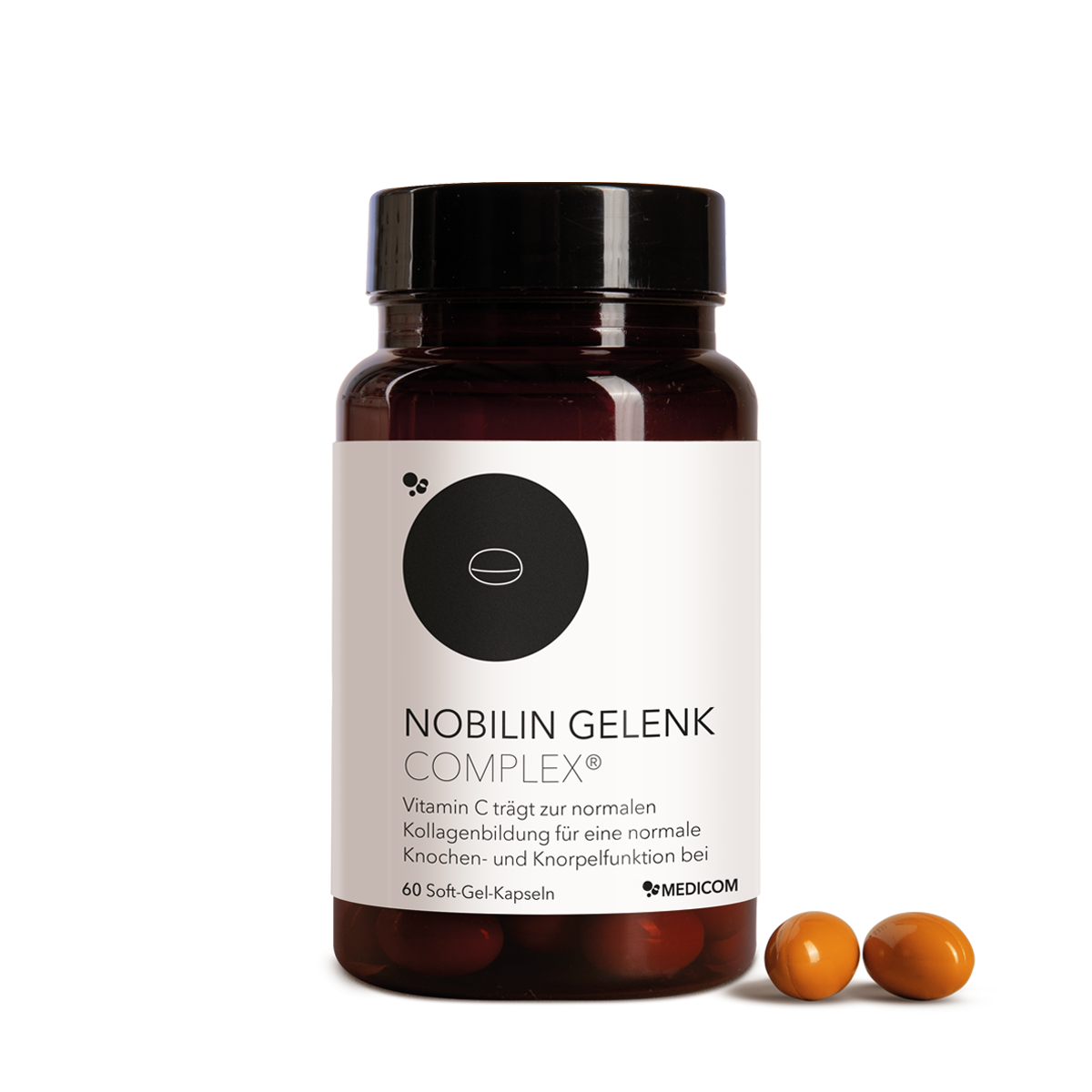
Nobilin Joint Complex®
With curcumin extract, frankincense and hemp oil
Vitamin E
Therapy with high-dose vitamin E has shown in studies that, when used long-term, it has similarly positive effects to the use of anti-inflammatory painkillers (NSAIDs), or that the dosage of the latter can be reduced.
Chondroitin and Glucosamine
It is important to discuss this with your doctor or orthopedist, as there can certainly be interactions with other medications, such as blood thinners. Chondroitin sulfate and glucosamine sulfate are said to be helpful for supporting cartilage nutrition. Both substances are also found naturally in joint cartilage and can optimize cartilage nutrition.
Vitamin C
Vitamin C, which is involved in collagen synthesis, should also be supplied in sufficient quantities through diet or a supplement. Vitamin C has antioxidant properties and is necessary for building the most important structural protein in the body – collagen. This plays an important role in the health of cartilage, tendons, ligaments, and joints. It is important that it can favor cartilage regeneration.
Omega 3 and Omega 6
In your diet, you should also pay attention to a good ratio of essential fatty acids. Omega-3 and omega-6 fatty acids should be in an optimal ratio to one another. In particular, one should aim for a high proportion of omega-3 fatty acids. A good ratio of essential fatty acids to each other can be found in, for example, hemp or linseed oil. It makes sense to get expert and individual advice.
Conclusion
Joint pain can have a wide variety of causes. Wear and tear, chronic and acute inflammation, hardened or shortened muscles due to too little or one-sided movement, and autoimmune and metabolic diseases are frequent reasons why we may suffer from painful movement restrictions. In a new series, we therefore want to address four diseases that are particularly frequent causes of joint pain.
Are you interested in the connection between joints and nutrition? Then we recommend reading: Joint-healthy nutrition? Here is how.