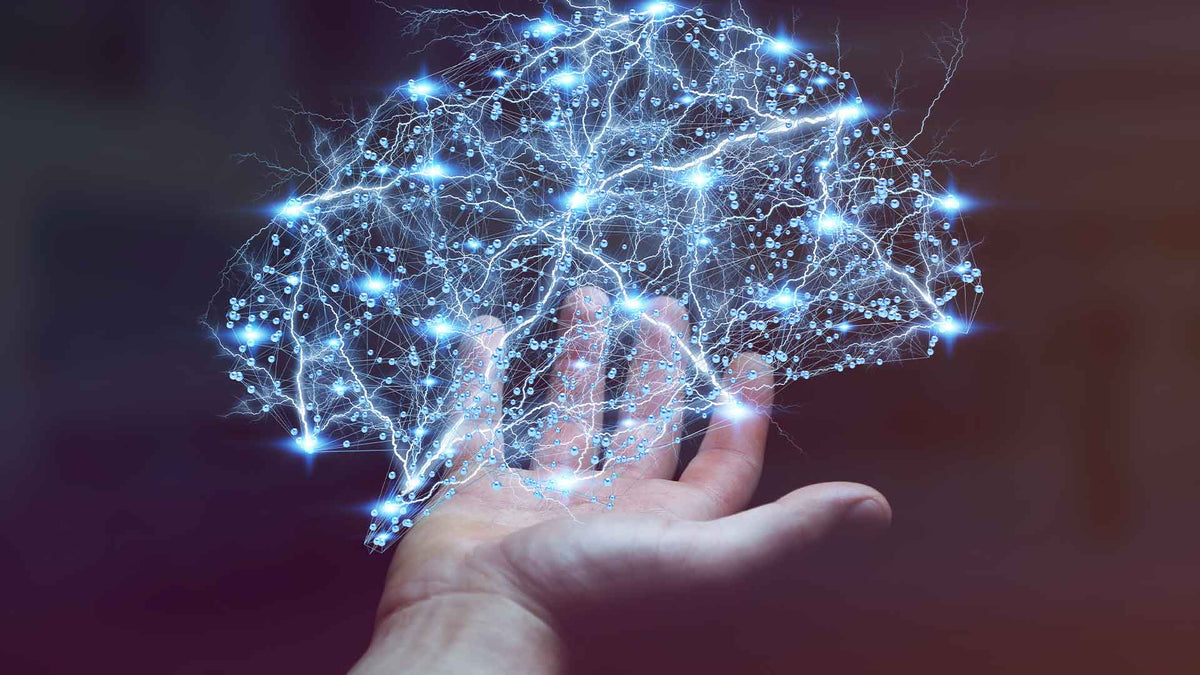
How does our brain work, how is it structured, and how can we maintain our brain functions into old age? Brain researcher Prof. Martin Korte provides answers to these questions. Listen to the podcast now.
About the person:
Prof. Martin Korte, born in 1964, is a professor of neurobiology at the Technical University of Braunschweig. The renowned learning researcher is an author. His numerous publications include: "Wir sind Gedächtnis" (We Are Memory).
Medicom: Mr. Korte, in your book “Wir sind Gedächtnis“ you dedicate yourself in detail and with passion to exactly this function of the brain. What exactly fascinates you so much about it that it resulted in an entire book?
Prof. Korte: This has become my entire field of work because I truly believe that by researching the brain—especially through the mechanisms of memory—we learn a great deal about ourselves, but also about societies and cultures. For culture can only emerge where memories are passed on to the next generation. Furthermore, the topic fascinates me because it is simply so incredibly complex.
Medicom: You say in the book that our memory determines who we are. Could you briefly explain that?
Prof. Korte: In previous years, it was often claimed that our genetic makeup determines who we are. I do not want to deny that genetic components play a role in how we become the people we are, but interaction with the environment and the experiences we have along the way—and the insights we draw from them to plan the future—play a much more important role. This means that how we master future problems depends significantly on what we have learned.
Many believe we have memory in order to remember things. That is not quite right. As we know today, we have it much more for the purpose of planning the future. Beyond that, memory also determines what we think about ourselves and how we repeatedly remind ourselves who we are through interactions with other people.
Memory determines what we think about ourselves.
Medicom: Can you explain in a few sentences how the process of remembering actually works?
Prof. Korte: Interestingly, we always think that when we remember an autobiographical experience, for example, we are traveling back to the time when we had the experience. But that is not correct at all. We are traveling back to the moment when we last reported on or thought about the event.
Medicom: Married couples often tell very different versions of a shared vacation. Both usually claim to be right. Why is that?
Prof. Korte: Whenever we remember something, it is saved anew. In the process, current feelings and current events are incorporated into the original memory trace, so that memories change over the course of our lives. Often, events are invented and added, because we only remember key points and fill in the rest associatively or based on probabilities. While this is not always accurate, it is an extremely effective form of storage. And that is how different versions of one and the same experienced event come about for a group of people.
Medicom: Memory does sometimes have complete lapses. Doesn’t our clever brain have a backup for such cases?
Prof. Korte: There are sometimes situations where something is on the tip of our tongue and we just can't recall it. But that does not mean the information is lost. At that moment, we have simply formed an incorrect association that the brain keeps returning to. In this case, the only thing that helps is to leave the situation and return to what you want to remember at a later time. A classic example is the PIN code at an ATM. It can suddenly be gone. The only thing that helps there is to stay calm and try again later.
Medicom: Memory seems particularly good at storing sequences and turning them into habits. However, many habits are not beneficial to us at all. What can be done about unwanted habits?
Prof. Korte: First of all, habits are extremely effective ways of processing information because they take place in brain structures located below the cerebral cortex, and thus require neither our attention nor our concentration. However, it is helpful to keep questioning yourself throughout the day: Why did I react the way I did in this or that situation? When it comes to establishing bad habits or even addictions, one should above all avoid the context, i.e., the situations in which one engages in these habits.
It is helpful to keep questioning yourself throughout the day: Why did I react the way I did in this or that situation?
Medicom: Today, more and more information is bombarding us, especially through the internet. Is our memory growing with the tasks, or are we overwhelming it without even noticing?
Prof. Korte: Our working memory has a very small processing capacity and is constantly being overwhelmed today. Simply because we try to process too much information within too short a time via different channels. On the other hand, we are training our factual memory—our knowledge—far too little nowadays because people think they can look up all sorts of things with a single mouse click. As a result, our long-term memory is atrophying. And that fills me with concern, because the more we know, the easier it is for us to acquire new knowledge and to distinguish between true and false news.
The 5-L rule for the brain: Learning, Locomotion (walking), Loving, Laughing, Lachs (salmon)
Medicom: What should one do to maintain memory performance for as long as possible?
Prof. Korte: Simple rules are important here. That is why I have established the so-called 5-L rule. On one hand, there is Learning. Those who learn throughout their lives keep their brain young and strengthen their memory as well as their cognitive abilities well into old age. On the other hand, physical activity helps both memory and the brain. This is represented by Locomotion (Laufen) as the second L. Especially in the areas that serve as filters for memory, exercise ensures that new nerve cells can be formed. As the third L, Loving (Lieben), or social interaction. Being active in clubs or charity work helps to maintain memory functions and other brain functions.
Furthermore, one should also pause occasionally in a situation, as one does when Laughing (Lachen). That would be the fourth L. The fifth L is Salmon (Lachs), because fish fats have proven to be positive for the brain. However, one should also pay attention to what one should not eat and avoid massive obesity. In general, one should have a bit of self-confidence. Because a brain calibrates its performance based on what it believes it is capable of achieving.
Medicom: Thank you very much for the conversation!
• Has this piqued your curiosity? Do you want to know more about salmon or unsaturated fatty acids? Learn more about Omega-3 here.