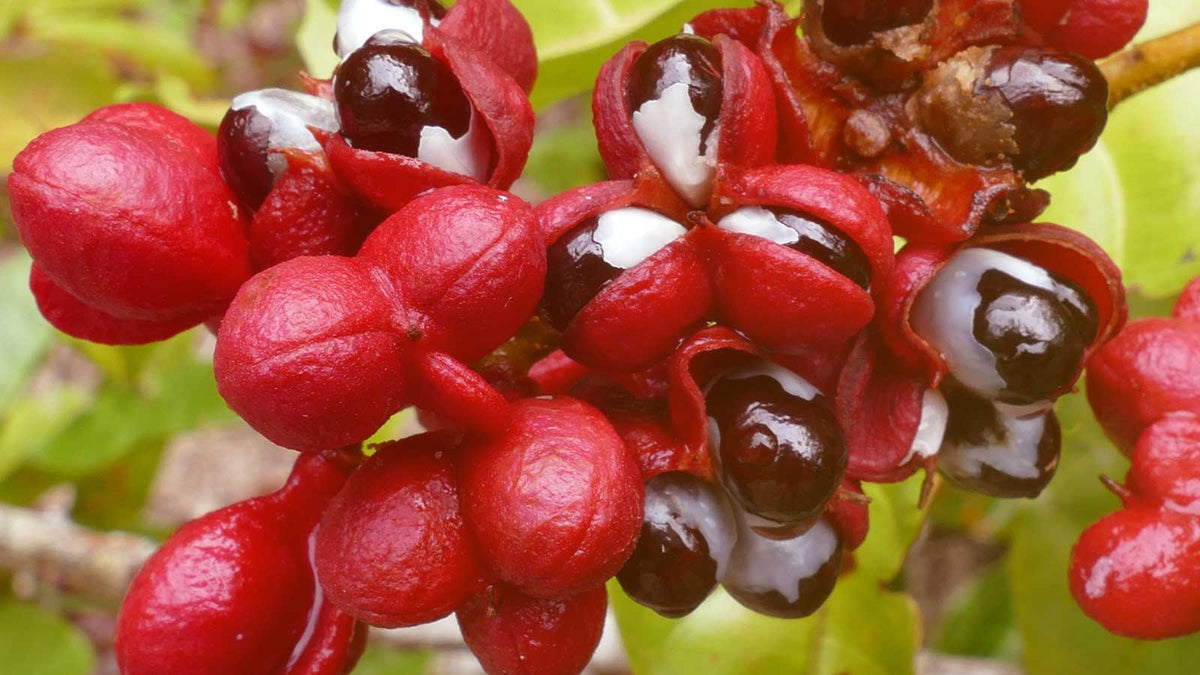
Guarana is a tropical plant found in the Amazon lowlands of Venezuela and Brazil. It has long been known to the indigenous peoples of the Amazon as a medicinal plant, and people in other parts of the world are also increasingly valuing guarana as a natural energy booster.
Guarana, a legendary Amazonian plant
Guarana (Paullinia cupana Kunth) is a plant from the soapberry family. Its name is derived from the indigenous Guaraní tribe. It is a woody vine that can grow up to 10 m high. It is perennial and evergreen. Its approximately 20 to 30 cm long leaves are leathery and odd-pinnate, while the small, yellowish-white flowers grow in clusters. When the ripe, reddish capsule fruit bursts open, it releases a green to black seed that features a white aril on one side. The burst-open fruit strongly resembles the shape of a human eye – the reason for more than one legend among Amazonian tribes.
Ingredients and effects
The fruit and its seeds have a high caffeine content of up to 8% in dry matter. As such, guarana is on par with coffee in its stimulating effect. In addition, it contains mainly tannins and catechins. Smaller amounts of theobromine and theophylline, as well as saponins, starch, and minerals, are also present.
Guarana caffeine combats fatigue by stimulating the heart and circulation. It also promotes concentration, performance, and gastric juice secretion, and can additionally have a diuretic effect.
What you should keep in mind when taking guarana
Since individual tolerance to caffeine varies, you should, as a precaution, not exceed the maximum daily dose of 400 mg of caffeine (approx. 7 to 11 grams of guarana). Insomnia, irritability, heart palpitations, and gastrointestinal complaints can be potential side effects. In the case of cardiac arrhythmia, high blood pressure, liver problems, or an overactive thyroid, you should stick to dosages of a maximum of approx. 100 mg (approx. 2 to 3 g of guarana).
• Would you like to know more about products that can support you during challenging times? Click here.