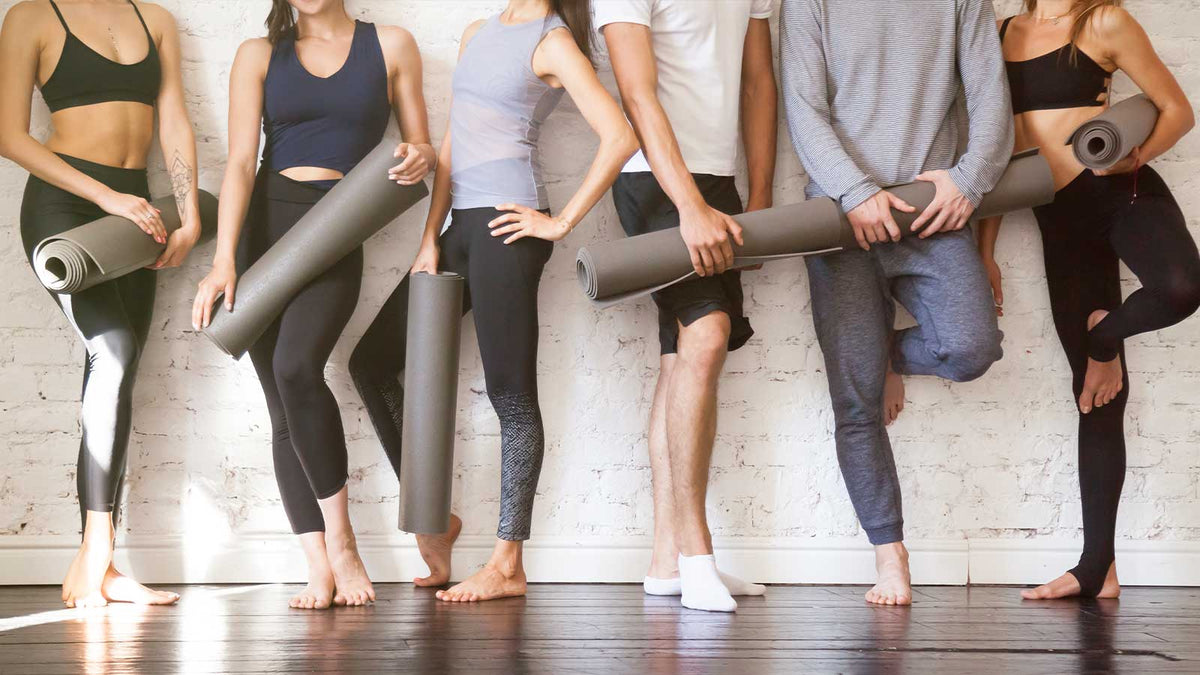
You can benefit from the Pilates training method in a variety of ways. After just a short training period, you can improve your posture, balance, and flexibility with these proven exercises. Above all, you can strengthen your core muscles, which has a preventative or alleviating effect, especially for lower back problems. Find out more about this systematic full-body workout and its benefits here.
Pilates – The History
The method was developed by Joseph Hubertus Pilates (1883 – 1967). During the First World War, while interned in Britain as a German national, he developed a holistic body training program for himself and his fellow internees. He initially called the method "Contrology" because his approach centered on gaining mental control over one's own muscles. Beyond physical fitness and healthy posture, Pilates was always concerned with mental strength, and he saw these qualities as being interconnected. During his subsequent time in Hamburg (1920 to 1925), Pilates reportedly taught both the Hamburg police and private clients, and he also taught self-defense techniques. It was around this time that Pilates also developed so-called Pilates machines. Eventually, Pilates moved to New York, where he and his future wife, Clara, opened a training studio.
Pilates – The Legacy
After his death, the Pilates method was primarily kept alive and popularized by his student, Romana Kryzanowska. Today, millions of people, especially in the Western world, train this way. In addition, there are Pilates-inspired workouts such as SLT, Studio MDR, or Brooklyn Bodyburn.
The Method
The more than 500 exercises in the Pilates method combine stretching, strength exercises, coordination, and conscious breathing. They primarily target the strengthening of the abdominal, back, and pelvic floor muscles, as well as the inner thighs. In German, this is referred to as the "Rumpf," while in English, it is called the core. Popular core training is, therefore, trunk training.
Many Pilates instructors also refer to the supportive muscles around the center of the body as the "Powerhouse." Pilates specifically addresses the muscle groups that are rarely trained, namely the so-called deep muscles, which are located deeper in the body and are generally smaller and weaker. This is despite the fact that they are of great importance for your posture, resilience, and general body strength. In addition to strengthening the muscles, Pilates is also about increasing stamina, stimulating circulation, improving coordination and body awareness, and training concentration.
The Principles
To better understand what is behind the term "Pilates," it is helpful to mention the six principles that Gail Eisen and Philip Friedman listed in the first book on Pilates in 1980: concentration, centering, control, breathing, precision, and flow. It is therefore important for practicing the method correctly that you truly focus on the exercises, become aware of your body, breathe consciously, and perform the postures with precision and the movements slowly and fluidly. This is why most Pilates classes have no background music, and conversation is not permitted. Concentration is important in order to gain increasing control over the various muscle groups and, gradually, to be able to perform coordinationally demanding exercises.
What should I consider when training in Pilates?
Never mind books or YouTube videos: As a beginner, you should book at least one hour with a reputable instructor in a studio or online. Because even if many exercises look easy, they are not, and the details are crucial for proper execution. After the introduction, you can work alone or in a group with machines developed by Pilates for support. These are called the barrel, Cadillac, chair, reformer, and spine corrector. So-called mat training without equipment is also demanding. Tools such as the Pilates roller, exercise balls, Pilates rings, and elastic bands are used here. Take it slow and do not overexert yourself with the initially quite unfamiliar strains.
Do not be surprised by muscle soreness, and allow one to two days for recovery in between. Pilates will not build you significant, externally visible muscle mass, but you are doing something much more important: you are strengthening yourself from within. That is why a correctly executed Pilates workout is a perfect foundation for other sports such as running, swimming, yoga, or boxing.
A motivating interview with movement and fitness coach Gesine Ratajczyk can be found here.
Are you interested in the topic of movement? You can find more on this here on the #LEBENNURBESSER blog here.
Do you want to know which nutrients support your musculoskeletal system? You can find out more here.