
In addition to the causes commonly known for joint pain, such as osteoarthritis and rheumatoid arthritis, there are other conditions that laypeople often struggle to categorize symptomatically. One of these is ankylosing spondylitis, a chronic inflammatory disease belonging to the rheumatic spectrum. Here is an overview of the most important information.
What is ankylosing spondylitis?
Ankylosing spondylitis, also known as Bechterew's disease, is one of the most common rheumatic diseases. At its core, it is a chronic inflammatory spinal disease that also affects the sacroiliac joint. In the worst-case scenario, the disease can lead to complete stiffening of the spine, the so-called “bamboo spine.”
In addition to the spine and the sacroiliac joints, other joints, tendons, and internal organs can also be affected by the disease. Ankylosing spondylitis is an autoimmune disease, meaning that a dysregulation of the immune system causes healthy tissue to be attacked and destroyed. To date, the disease is incurable; however, early detection and consistent therapy can very positively influence its progression in many cases.
Who is affected by ankylosing spondylitis?
The disease was first named after the Russian neurologist "Vladimir Bechterew" (1857-1927). However, the disease is said to have already existed in ancient Egypt. Archaeological finds of Egyptian pharaohs have revealed spinal changes that point to the disease.
It was previously assumed that the disease primarily affected men. However, newer surveys and more modern examination methods mean this assumption is no longer confirmed today, and it is assumed there is a similar ratio between men and women. In Germany, approximately 100,000–150,000 cases have been diagnosed. The number of unreported cases is likely to be significantly higher, as milder cases are often not recognized.
According to current studies, however, how ankylosing spondylitis manifests depends heavily on gender. In women, for example, the inflammatory component of the disease predominates. This can lead to misdiagnoses for a long period of time. Since tendon attachments and other joints are also more frequently affected in women, the clinical presentation can also resemble rheumatoid arthritis or fibromyalgia (colloquially also known as "soft tissue rheumatism").
What symptoms does ankylosing spondylitis show?
A major problem for early diagnosis is the often very different and wide-ranging symptoms of the disease. In addition to classic main symptoms, which are often difficult to distinguish from other joint diseases, especially in the early stages, there are also some non-specific accompanying symptoms that should also prompt consideration of ankylosing spondylitis.
The main symptoms of the disease include:
- Morning stiffness with classic "start-up pain," which usually disappears after about 30 minutes
- Deep-seated back pain that occurs primarily at night
- Back pain that primarily affects the lower lumbar spine and buttock area. This can radiate into the thighs.
- Pain that usually improves with movement
- Pain that worsens with impact, such as coughing or jumping on a hard surface
- Pain that lasts longer than three months (an indication of a chronic inflammatory disease)
- Systemic inflammation, meaning other joints, tendons, and organs also cause discomfort, which, however, is often not linked to the condition.
Non-specific symptoms and side effects are mentioned below and should always raise suspicion of ankylosing spondylitis in conjunction with deep-seated back pain:
- Exhaustion, fatigue, elevated temperature, weight loss, elevated inflammation markers (as a result of the autoimmune reaction)
- Unilateral inflammation in hip, knee, or ankle joints (bilateral manifestation is typical for rheumatoid arthritis).
- Inflammation of tendon attachments, for example, the Achilles tendon
- Eye inflammation (uveitis)
- Vertebral fractures
- Inflammatory bowel diseases (a connection exists in one in ten patients)
- Rarely, other organs such as the heart or kidneys are also affected
In case of suspicion, the presence of the HLA-B27 gene, among other things, plays an important role. Bechterew's patients exhibit this gene disproportionately often.
How is ankylosing spondylitis treated?
Ankylosing spondylitis is incurable, but it is usually treatable conservatively. In general, thanks to state-of-the-art imaging procedures, ankylosing spondylitis is now often detected earlier, so that severe courses are avoided more frequently. Early diagnosis allows for a better influence on the progression of this disease, which often severely impairs quality of life.
The main goal of treatment, in addition to pain relief, is primarily to maintain the mobility of the spine. The therapy therefore consists mainly of anti-inflammatory drugs and movement therapy such as physiotherapy. Surgical interventions are only rarely necessary.
Regarding medication, anti-inflammatory drugs such as NSAIDs (non-steroidal anti-inflammatory drugs) are primarily used. Cortisone preparations can also be indicated. In more severe cases, long-term basal medications such as MTX (methotrexate) are also used—a drug indicated for, among other things, chronic inflammatory diseases. However, medications like these often have side effects, some of which are serious, and should always be discussed and weighed carefully with a specialist (rheumatologist) regarding dosage and necessity.
In addition to drug therapy and classic physiotherapy (movement therapy), physical therapy is also frequently prescribed. This includes, for example, warming baths, electrotherapy, and massages, as well as fango and mud packs or regular visits to thermal baths. In phases of acute flare-ups, cold treatments can also make sense. Fortunately, surgeries rarely play a role in treatment.
In advanced stages of the disease with severe ossification and associated stiffening of the spine or in the event of joint destruction, surgical interventions may become necessary with the aim of improving the patient's quality of life.
What can I contribute myself?
Whenever possible, mobility should be maintained through joint-friendly sports such as swimming or Nordic walking. Daily gymnastics are also a must. For this, you should have an experienced physiotherapist demonstrate specific exercises that are suitable depending on the severity of the disease.
Breathing therapy can also be useful if stiffening of the thoracic spine also leads to a limitation in the mobility of the ribcage. Relaxation therapies such as Qi Gong, Yoga, or Tai Chi can also have a positive effect. If there is no time for all of this, a walk at the end of the day can, in an emergency, replace the lack of exercise at least partially.
What diet is recommended?
In general, there are no known positive influences on ankylosing spondylitis through diet that are as well scientifically documented as those for rheumatoid arthritis, for example. However, this may also be because there is less research into the diet related to this specific disease.
Since ankylosing spondylitis is not a mechanical disease but a chronic inflammatory process, one can certainly infer that an anti-inflammatory diet based on plenty of fruit and vegetables (antioxidants), good protein, for example from plant sources (nuts, legumes, hemp protein powder), as well as high-quality essential fatty acids such as gamma-linolenic acid or high-quality omega-3 fatty acids, can have a positive effect.
Both strong antioxidants or radical scavengers—such as certain vitamins, secondary plant compounds, and trace elements (e.g., Vitamin C, Vitamin E, or Selenium)—as well as essential fatty acids have an influence on an anti-inflammatory metabolic state in the body. A high proportion of antioxidants in the diet can more easily neutralize cell-damaging, oxidative processes (radical oxygen compounds) that fuel inflammation.
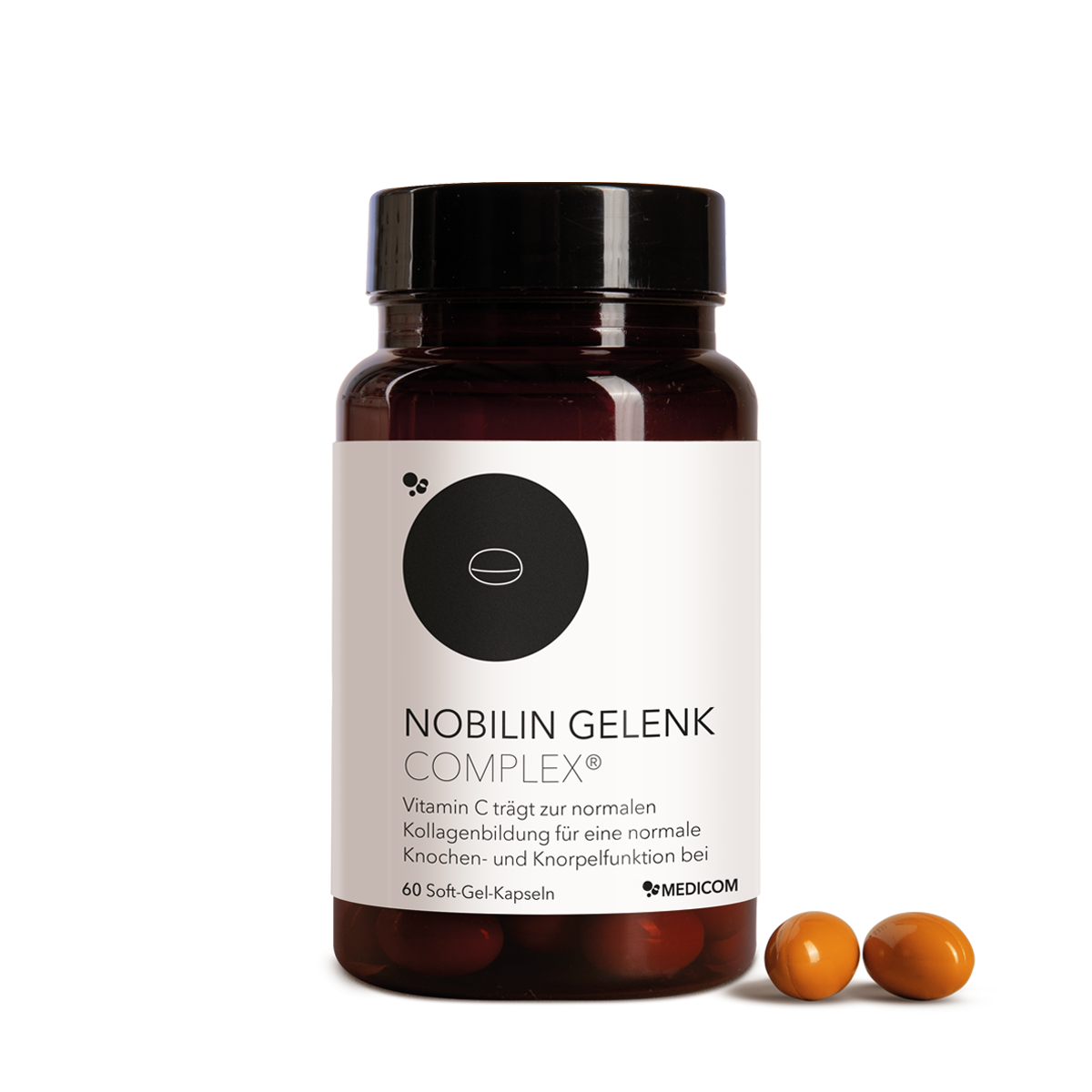
Nobilin Joint Complex®
With curcumin extract, frankincense and hemp oil
Plant enzymes such as bromelain (from pineapple) also have anti-inflammatory properties. Frankincense or turmeric, which are also contained in nutritional supplements, are highly valued in Indian and traditional Chinese medicine for inflammatory diseases.
Conclusion
Ankylosing spondylitis is a chronic inflammatory disease of the rheumatic spectrum. If the disease is detected early, it can generally be treated well, but it is not curable. Among other things, a genetic predisposition seems to play a certain role in the development of the disease.
The diagnosis is often complicated because ankylosing spondylitis has a diverse clinical presentation that is initially often confused with other diseases. Chronic pain in the lower lumbar spine and the sacroiliac joints that persists for more than three months and is accompanied by other non-specific symptoms such as fatigue and reduced performance should always prompt consideration of ankylosing spondylitis.
In addition to anti-inflammatory drugs, physiotherapy, and physical applications, one must ensure regular exercise to prevent physical limitations as much as possible in the long term. Joint-friendly sports are particularly suitable for this.
A vitamin-rich, antioxidant, plant-based diet and essential fatty acids such as gamma-linolenic acid (found in evening primrose or borage oil) or omega-3 fatty acids (e.g., in fatty sea fish) ensure a healthy metabolic state, through which inflammatory processes can be blocked more easily.
Certain herbal medicines can also be used as a supplement on a trial basis after consultation with a doctor. It should be emphasized that ankylosing spondylitis is a serious autoimmune disease that, if left untreated, can lead to maximum limitation of quality of life. Therefore, the measures mentioned are only ever a supplement and never a substitute. Expert examination and consultation by a rheumatologist is just as indispensable in case of suspected disease as early conventional medical treatment once a diagnosis is confirmed.
Do you want to know more about joint pain and exercise? Then listen to this podcast with naturopathic physician Peter Emmrich: Joint pain: The cause lies in the diet
Or are you generally interested in the topic of joint pain? Click here. Joint pain: Most common causes and therapies.