
Hello and welcome to a new Medicom Krill Oil Special! We are glad you tuned in. Today, we are discussing a topic that is literally close to our hearts: your heart health. Have you ever wondered how you can strengthen and protect your heart? Krill oil has an impressive effect on our heart health. We will now take a close look at why that is.
The heart as a central organ
The heart is the central organ in our body. Healthy heart function is the basis for all other processes in our body and is crucial for our well-being. Therefore, we want to address the various aspects of heart health today. And we are exploring the question of how krill oil can support our heart in its vital task.
Let us briefly examine the basic functions of the heart. The heart is the vital engine of our cardiovascular system. It pumps blood through our arteries and veins. In doing so, it supplies our organism with oxygen, hormones, and nutrients. At the same time, it transports waste products to the excretory organs such as the lungs, kidneys, and skin.
The pumping of the heart occurs rhythmically and in a coordinated manner, which maintains blood pressure and provides the entire organism with vital energy. The heart is, therefore, the central organ in a complex system. And, of course, the heart's function can also be disrupted.
Risks to heart health
Among the best-known cardiovascular problems that occur most frequently in Germany are:
-High blood pressure
-Coronary heart diseases
-Cardiac arrhythmias
-Heart failure
-Strokes.
Let’s look at these in detail.
High blood pressure
The medical term for high blood pressure is arterial hypertension. This is a condition in which the blood pressure in the arteries is permanently elevated. Over time, this makes the vessel walls thicker and rougher. Deposits attach themselves more quickly, and the channel through which the blood can flow narrows. This increases the risk of heart disease and strokes, but organs such as the kidneys can also be affected. The insidious thing about high blood pressure is that it is often only noticed when damage has already occurred.
Coronary heart diseases
In so-called coronary heart diseases, abbreviated CHD, the blood vessels that supply the heart with blood, the coronary arteries, are narrowed by deposits. This leads to reduced blood flow and a lack of oxygen in the heart muscle, which can eventually lead to heart attacks. The cause of CHD is often atherosclerosis, i.e., hardening of the arteries. This, in turn, is promoted by high blood pressure, smoking, obesity, regular alcohol consumption, and diabetes mellitus.
Cardiac arrhythmias
Cardiac arrhythmias are among the most common heart diseases. Here, the heart beats irregularly, which is unfavorable for the body's supply in the long run. Various factors can be the cause, ranging from stress to structural heart problems, for example, heart valves or heart walls that have changed and impair heart function.
Heart failure
Also on the list of common heart diseases is heart failure, also known as cardiac insufficiency. This is a condition where the heart muscle can no longer pump effectively and does not provide enough blood for the body. The consequences can be: weakness, shortness of breath, and fluid retention.
Stroke
A stroke, on the other hand, involves a sudden loss of blood supply to the brain. The cause lies in a blockage or bleeding in the blood vessels. The consequences can be severe and severely restrict those affected.
Such cardiovascular diseases are often linked. They can be influenced by common risk factors such as smoking, an unhealthy diet, lack of exercise, obesity, and genetic predisposition. A healthy lifestyle, regular medical check-ups, and early intervention play a decisive role in the prevention and treatment of these heart problems.
What is krill oil and how does it affect heart health?
Of particular importance here is the supply of the right nutrients. And this is where krill oil comes into play.
A brief reminder: Krill oil is obtained from small crustaceans, specifically from Antarctic krill. If you would like to learn more about krill, simply listen to our podcast episode 1 titled: “Insights into the mysterious life of Antarctic crustaceans”.
In recent years, krill oil has become increasingly popular as a dietary supplement. There are various reasons for this. First, there are the ingredients important for the human organism – I will go into detail about these in a moment – and second, the diet of the krill. It feeds on algae and is thus quite low in the food chain. This means: Krill is a particularly pure source of nutrients.
Now to its high-quality ingredients. Krill oil is good for the heart partly because of its high content of omega-3 fatty acids. Omega-3 fatty acids are essential fatty acids, meaning substances we need but which our body cannot produce itself. They must be ingested through food. EPA, i.e., eicosapentaenoic acid, and DHA, which stands for docosahexaenoic acid, are particularly interesting. This is because precisely these omega-3 fatty acids have a positive effect on normal heart function when taken daily at a dose of 250 mg.
EPA and DHA – the omega-3 fatty acids
EPA supports the reduction of inflammation in the body, especially in the blood vessels. And inflammation is considered the main trigger for heart disease.
On the other hand, DHA plays a significant role in the structure of cell membranes, including those of heart cells. An adequate supply of DHA is therefore excellent support for the heart muscle.
The biochemical processes that take place here are fascinating. EPA and DHA influence the signaling pathways that control inflammatory processes in the body. They also interact with other molecules to influence blood composition. For example, replacing saturated fatty acids with monounsaturated and/or polyunsaturated fatty acids in the diet, such as those in krill oil, can help maintain normal cholesterol levels in the blood.
Let us briefly recall the blood lipid values we know from the results of a blood test. These include triglycerides, a type of fat molecule in the blood, HDL cholesterol, referred to as "good" cholesterol, and LDL cholesterol, popularly known as "bad" cholesterol. And how can krill oil positively influence these blood lipid values? EPA and DHA can lower triglyceride levels and optimize the ratio of LDL cholesterol to HDL cholesterol. This is an important aspect. Because high triglyceride levels and imbalances in cholesterol levels can increase the risk of heart disease.
Phospholipids for heart cells
Let us now turn to another ingredient of krill oil for heart health: phospholipids. The omega-3 fatty acids in krill oil are bound to phospholipids. These phospholipid molecules improve the bioavailability of the fatty acids. This means: They are more efficiently absorbed and utilized by the body. Phospholipids integrate seamlessly into cell membranes, including cells in the heart tissue, thus promoting optimal functioning.
This mechanism ensures that the omega-3 fatty acids reach the parts of the body where they are needed quickly. In a sense, there is a targeted delivery to where the essential nutrients can unfold their greatest benefits. Imagine phospholipids like a highway and, ultimately, like a builder who optimally integrates the rapidly delivered nutrients into the cells.
Choline for the cardiovascular system
But that's not all. Krill oil contains another, lesser-known ingredient that supports heart health, namely choline. This is an essential micronutrient that occurs naturally in krill oil. The positive effect of choline on the heart has become clear in various studies. But more on that later.
Choline plays a decisive role in methionine metabolism. Methionine is an amino acid involved in the formation of homocysteine. A high homocysteine level is considered a risk factor for atherosclerosis and cardiovascular diseases. Choline helps to regulate homocysteine levels and keep them at a healthy level.
Omega-3 fatty acids and choline work in a mutually beneficial interplay. This is what makes krill oil so interesting for comprehensive support of a healthy cardiovascular system.
Studies on krill oil and heart health
And what does science say? Studies have shown that krill oil is associated with improved cardiovascular health. The most important benefits observed are:
- the reduction of inflammation
- the improvement of blood lipid values
- and structural support for the heart muscle
A meta-analysis, i.e., a summary of several independent studies, from 2017 also suggested a positive effect of krill oil on the heart. It was shown here that the intake of krill oil over a period of at least two weeks had a regulating effect on the lipid concentration in the plasma. In other words: The "bad" LDL cholesterol levels and triglyceride levels were reduced, thus optimizing the composition of blood lipid values. (1)
In a randomized clinical trial by an Italian research team in 2016, the anti-inflammatory effects of krill oil were demonstrated, among other things. For clarification: Randomized means the study participants are assigned to two or more groups by chance and tested. In this case, the lipid-lowering and anti-inflammatory effects of krill oil were investigated. For this purpose, the researchers gave 25 slightly overweight participants 1,000 milligrams of omega-3 ethyl ester twice daily for four weeks, and after a break, another 500 milligrams of krill oil twice daily for four weeks.
Both could achieve positive effects on blood plasma. However, the intake of krill oil reduced CRP values more effectively. The abbreviation CRP stands for C-reactive protein. CRP values are inflammation markers in the blood count. (2)
These are fascinating results that show how good krill oil is for our cardiovascular system and our well-being. As always, you will find all the studies mentioned here linked in the show notes.
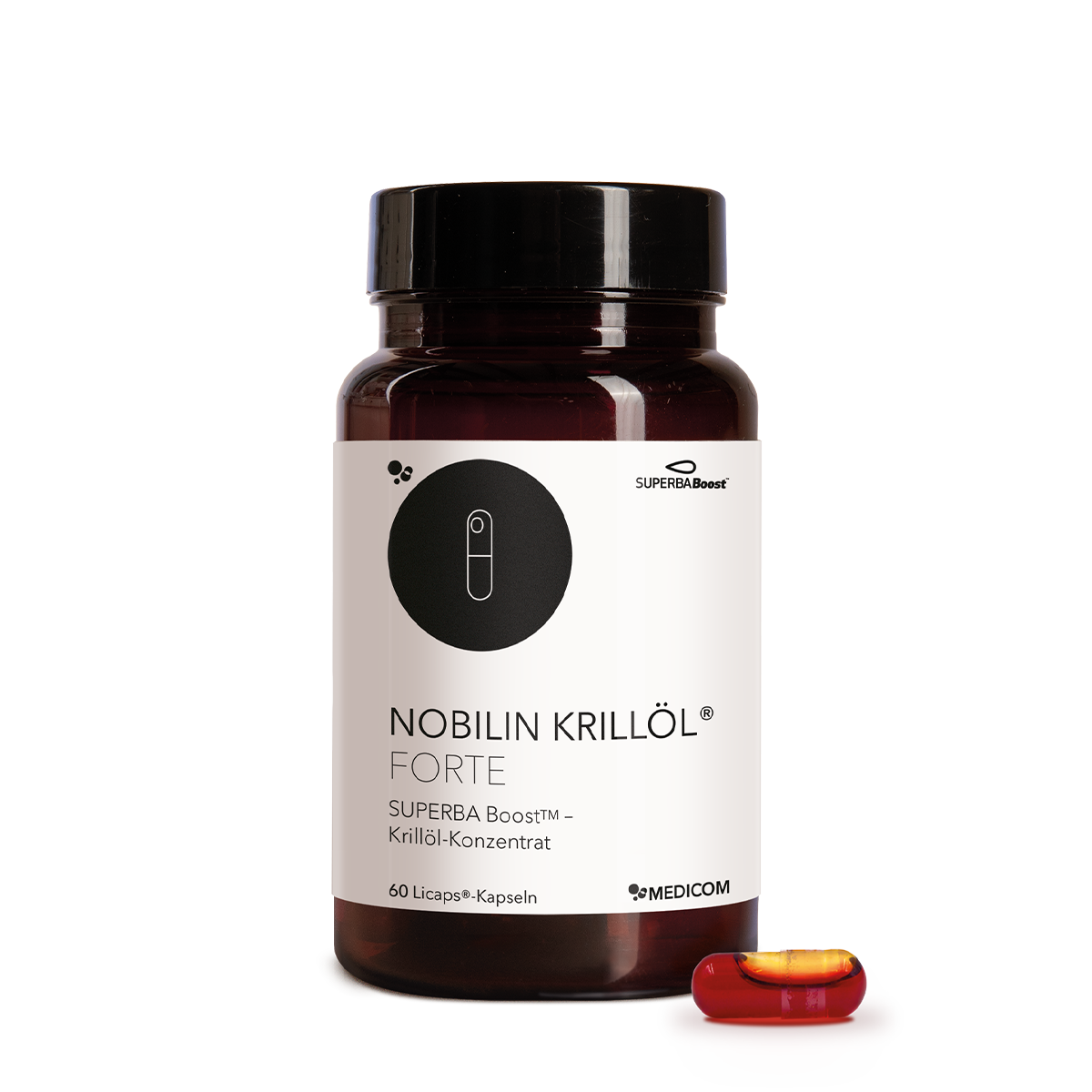
Nobilin Krill Oil® Forte
The best source of omega-3 in capsule form
How you can integrate krill oil into your everyday life
How can I now integrate krill oil into my diet? Krill oil is easy to digest, odorless, and tasteless. This saves you from the fishy and unpleasant burping when taking it.
If necessary, krill oil is best taken in capsule form, completely uncomplicated and daily. The European Food Safety Authority recommends a total daily intake of 250 mg of EPA and DHA to support the positive effect for normal heart function.
Of course, individual needs can vary. For example, the requirement is higher during pregnancy and breastfeeding. In case of doubt, talk to your trusted doctor about the optimal daily dose for you.
Conclusion
In summary: Krill oil has an amazing effect on the healthy functioning of our heart. Thanks to its omega-3 fatty acids, phospholipids, and choline, it supports the cardiovascular system in a multifaceted and interconnected way. For example, by regulating blood lipid levels and homocysteine levels.
Of course, krill oil is not a miracle cure. If you lead an unhealthy lifestyle with little sleep, a lot of stress, an unbalanced diet, and heavy nicotine or alcohol consumption, you cannot simply compensate for that by taking krill oil. Consider krill oil rather as one of several healthy building blocks for your heart health and integrate the regular intake of krill oil into your everyday life.
Well, that's it for today! Stay tuned to learn more about health and well-being. We look forward to welcoming you back here for our next podcast episode. And of course, we are always happy when you recommend us to others. You can also find all podcast episodes in the Medicom online magazine under Podcasts. Take care, stay active, and listen to your heart!
Study references:
1.) Meta-analysis from 2017 on the regulating effect of krill oil on lipid concentration in plasma: https://academic.oup.com/nutritionreviews/article/75/5/361/3078064?login=fals
2) Study from 2016 on the lipid-lowering and anti-inflammatory effect of krill oil: https://pubmed.ncbi.nlm.nih.gov/27279841/
• If you have further questions and would like to learn more about krill oil, do not hesitate to contact your trusted doctor or our free Medicom vital substance consultation at 0800 50 400 50.