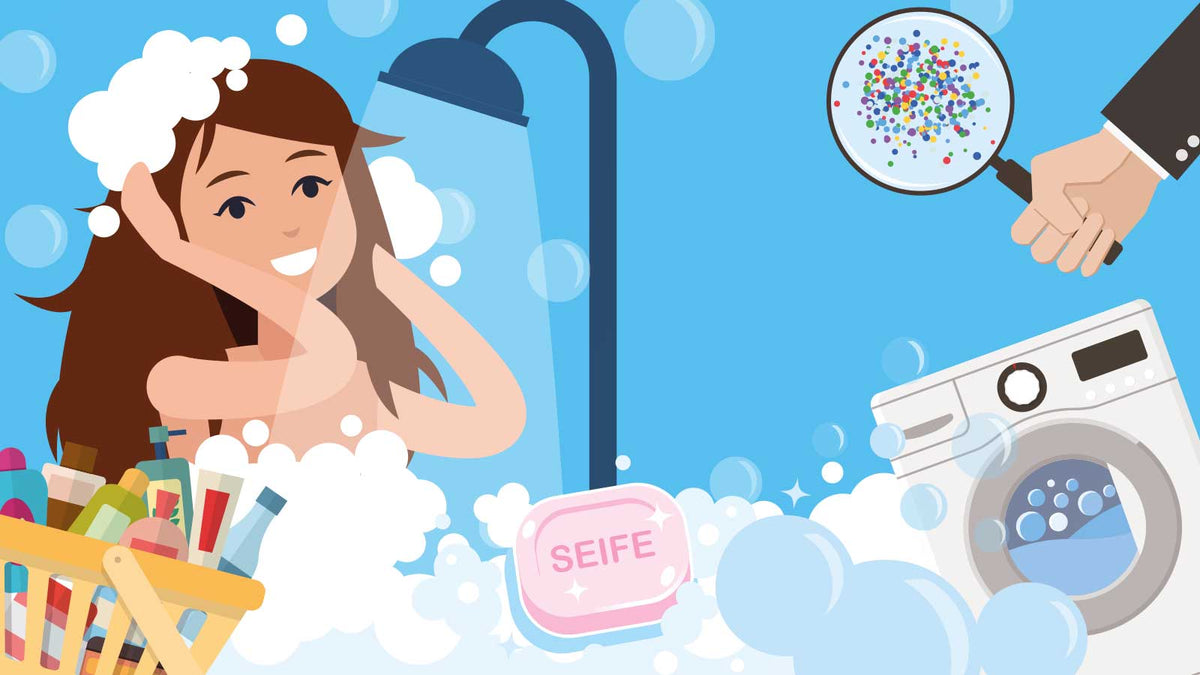
You can do a lot for the environment in the bathroom, too. In this article, you will learn about sustainable alternatives to environmentally harmful cosmetics and receive tips on how to save energy and avoid disposable waste and microplastics.
Say no to microplastics in the bathroom
Microplastics place a heavy burden on our health and the environment – because they enter our bodies not only through direct ingestion. The plastic particles are so small that they cannot be filtered by drain strainers or wastewater treatment plants. As a result, they enter the water supply unimpeded and contaminate it. This is the beginning of a vicious cycle: simply through our daily personal care using contaminated products, we flush large amounts of microplastics down the drain and into our waterways. Fish mistake the particles for food and eat them. Harmful microplastics occupy the animals' cells before ending up back on our plates as a "healthy" fish meal. Therefore, look for ecologically tested cosmetic products without microplastics or other harmful substances. By the way: The German Federation for the Environment and Nature Conservation (BUND) has compiled a list of products that contain microplastics.
Pay attention to ingredients in cosmetics
Various cosmetics can contain microplastics. You should be careful with ingredients such as polyethylene, polypropylene, nylon, polyacrylate, acrylates copolymer, or crosspolymer. They are contained in facial cleansers, scrubs, skincare creams (for example in day or anti-wrinkle creams), washing gels, lotions, shower gels and bath products, powders, foundations, concealers, blushes, shampoos, conditioners and styling products, eyeshadows, mascaras, eyeliners, eyebrow pencils, lipsticks and glosses, sunscreens, foot and hand care products, dental care products, as well as deodorants.
If you don't want to leave anything to chance in the bathroom either, buy only cosmetic products with relevant seals and from certification bodies such as EcoControl, NATRUE, ECOCERT, BDIH for controlled natural cosmetics, Naturland, or Demeter.
Brushing teeth sustainably
Toothpastes have long been on the list of cosmetic items with a high microplastic content and other substances harmful to health. However, you can achieve beautiful white teeth without abrasive plastic particles. More environmentally friendly and better for your health are, for example, toothpaste tablets, which you can get in zero-waste shops or now even in drugstores. Furthermore, toothpaste is easy to make yourself, for example with coconut oil, baking soda, and turmeric. Turmeric powder, which is particularly popular in Ayurveda, improves the bacterial environment in your oral cavity, has an anti-inflammatory effect on the gums, and conjures up white teeth. Another step toward avoiding microplastics in the bathroom.
"Codecheck" shopping aid
Apps such as "Codecheck" help you at the drugstore to ensure that products that are harmful to health and the environment do not even end up in your shopping basket. With the camera function on your smartphone, you can easily scan the barcodes of cosmetic products and immediately receive detailed information about any harmful ingredients they contain. Simple and easy to understand in a traffic light format: green means okay, red means questionable. In addition, alternative bio-certified items are displayed for the respective products. Another great app of this kind is "beatthemicrobead".
Cotton? You should rethink that!
Common cotton pads are not only wrapped in plastic; they are also made of valuable raw materials that are used only once and then end up in the bin as disposable waste. To remove your makeup more sustainably, you should switch to washable fabric cloths and rags, which can be easily cleaned in the washing machine.
The popular cotton swabs, often used for correcting makeup, are also usually made of plastic. Here, you should rather buy organic products made from renewable raw materials like bamboo, which are biodegradable and compostable. Recently, reusable silicone cotton swabs have even been offered in drugstores, which can be easily cleaned with water and soap.
Saving water and energy in the bathroom
Showering is significantly more energy-efficient than taking a bath. While a full bath consumes around 150 liters of drinking water, a thrifty five-minute shower requires a maximum of 50 liters of water. Moreover, showering is also much better for the dermal acid mantle of our skin than a long bath in warm water. Cold showers or contrast showers additionally promote the body's natural defenses.
You can also save energy when washing clothes, as the washing machine is a major water and energy guzzler in our households. To act in an environmentally friendly way here, you should always fully load the washing drum. And wash at low temperatures whenever possible. You should avoid pre-washing if possible.
The advantages of solid soaps and shampoos
Instead of shower gel and shampoo in plastic bottles, it is recommended to use "solid shampoo" and mild shower soap bars based on valuable oils such as coconut or olive and sugar surfactants. Not only does the environment benefit, but your skin will also thank you, as the soaps have a moisturizing effect due to the natural oils. The fragrant bars can be stored cleanly, for example, on cut slices of a loofah sponge. When damp, you can additionally use the sponges as a massaging scrub. In this way, you can replace the scrub tube at the same time!
Upcycling in the bathroom
Plastic containers from old shampoo or shower gel bottles that you already own can be upcycled. This means you can repurpose them and continue using them. For example, you can craft original pen holders for children out of empty shower gel dispensers. There are no limits to your imagination.
And if you want to join forces with others to take action against the mountains of waste: nature conservation organizations welcome active help, such as with litter-picking campaigns, as well as donations used to support environmental campaigns and ecological projects. Environmental organizations include, for example, NABU, BUND, WWF, and Greenpeace.
• You can find more sustainability tips for the household here.