Strong, healthy eyes are a valuable asset. We often only realize this when our vision fades or other problems arise. The good news: there is a lot we can do ourselves for good vision. This is what Beate Rinderer shows in her book “Natürlich besser sehen” (Naturally Seeing Better) – a kind of instruction manual for our eyes. You can find out more in our expert interview.
Medicom: You have published a book on naturally maintaining eyesight. Why?
Beate Rinderer: The book was created at the suggestion and request of many people who wanted a self-help book and reference work on the topic of “eye health.” Consequently, I wrote it as a sort of instruction manual for our eyes. In understandable language, I explain diseases, their causes and connections, and outline measures for an eye-healthy lifestyle. There are many ways to support your own eyes. And I want to convey this knowledge with the book.
Medicom: What are typical eye problems people face today?
Beate Rinderer: In addition to refractive errors like nearsightedness (myopia), farsightedness (hyperopia), presbyopia, or astigmatism, people frequently suffer from dry, irritated, red, strained, tired, inflamed, and watery eyes. Furthermore, people come to my practice suffering from allergic reactions, “floaters” (mouches volantes), or eyes that are very sensitive to light. In older age, the issues are largely serious degenerative eye diseases such as glaucoma and cataracts.
Medicom: How do we harm our eyes?
Beate Rinderer: Through rigid and sedentary vision, artificial light sources – e.g., from screens – and, above all, through an unfavorable diet that burdens the eyes. Additionally, an early and frequent use of glasses, especially if they are prescribed slightly too strong, is a gateway to serious eye diseases.
Medicom: In your book, you name three pillars for an "eye-healthy lifestyle." What are they?
Beate Rinderer: They are nutrition, movement, and relaxation.
For healthy eyes, we need vital nutrients from plants. Plant cells are the best fuel for our eye cells.
Medicom: What do you mean by "eye-healthy nutrition"?
Beate Rinderer: It can be said briefly and concisely: plant-based food is eye-healthy food! For healthy eyes, we need the vital nutrients from plants. As natural as possible and frequently eaten raw. Our body is actually optimally constructed for the digestion of plants and can absorb their power packs excellently. Plant cells are the best fuel for our eye cells. Animal products, on the other hand, especially meat and sausage, can have a problematic long-term effect on our eyes and other organs, such as our gut. This is because meat products decompose very quickly. The resulting waste products must therefore leave the body quickly so that no poisoning occurs.
However, we humans have a very long intestine – too long for our food. As a result, digestive waste remains in the body for too long. An indication that we have eaten the right thing is if we feel more vital and energetic after eating than we did before. If, on the other hand, we are tired after eating and need a coffee, then we should definitely put the content of our meal to the test. Enjoy more colorful salads, vegetables, nuts, sprouts, whole grains and rice, good oils, and delicious fruits instead.
Medicom: What role does movement play in our eye health, and why?
Beate Rinderer: Life is movement. For our eyes, movement is even vital. Why? Movement keeps our muscles strong. The eye is supplied with the vital nutrients we have ingested through food via the eye muscles. At the same time, the waste products that arise during the process of seeing are disposed of. If we lack eye musculature, our eye cannot remain healthy in the long term. Since our eyes are very robust, we often only notice poor and careless treatment of them in middle or later age: we need glasses. Sometimes our eyes show early on through feelings of dryness or high light sensitivity that something is no longer working as well. In the worst case, degenerative eye diseases such as cataracts or macular degeneration develop. These are often referred to as age-related, but in fact, they are behavioral.
Active seeing is the keyword. Unfortunately, our everyday life is strongly determined by motionless staring at nearby objects, e.g., through screen work, reading, writing, cell phones. We must interrupt this state through active eye movements and by purposefully performing eye exercises. It is no different than with other muscles: use it or lose it.
Medicom: And how do I best relax my eyes?
Beate Rinderer: For example, through so-called palming, which means placing your hands over your eyes while imagining energy flowing from your hands through your eyes. Breathing exercises, for example, Pranayama from Atma Kriya Yoga, are also good. Through this, we not only bring relaxation to the eyes, but also a lot of oxygen into the eyes and to our brain. Relaxation also includes our mindset, i.e., how well we handle the daily challenges of our lives. Can we remain positive when we don't feel richly gifted by our environment? Can we see the beautiful things, speak benevolently, and let things slide from time to time? That helps immensely. The simplest relaxation is a smile.
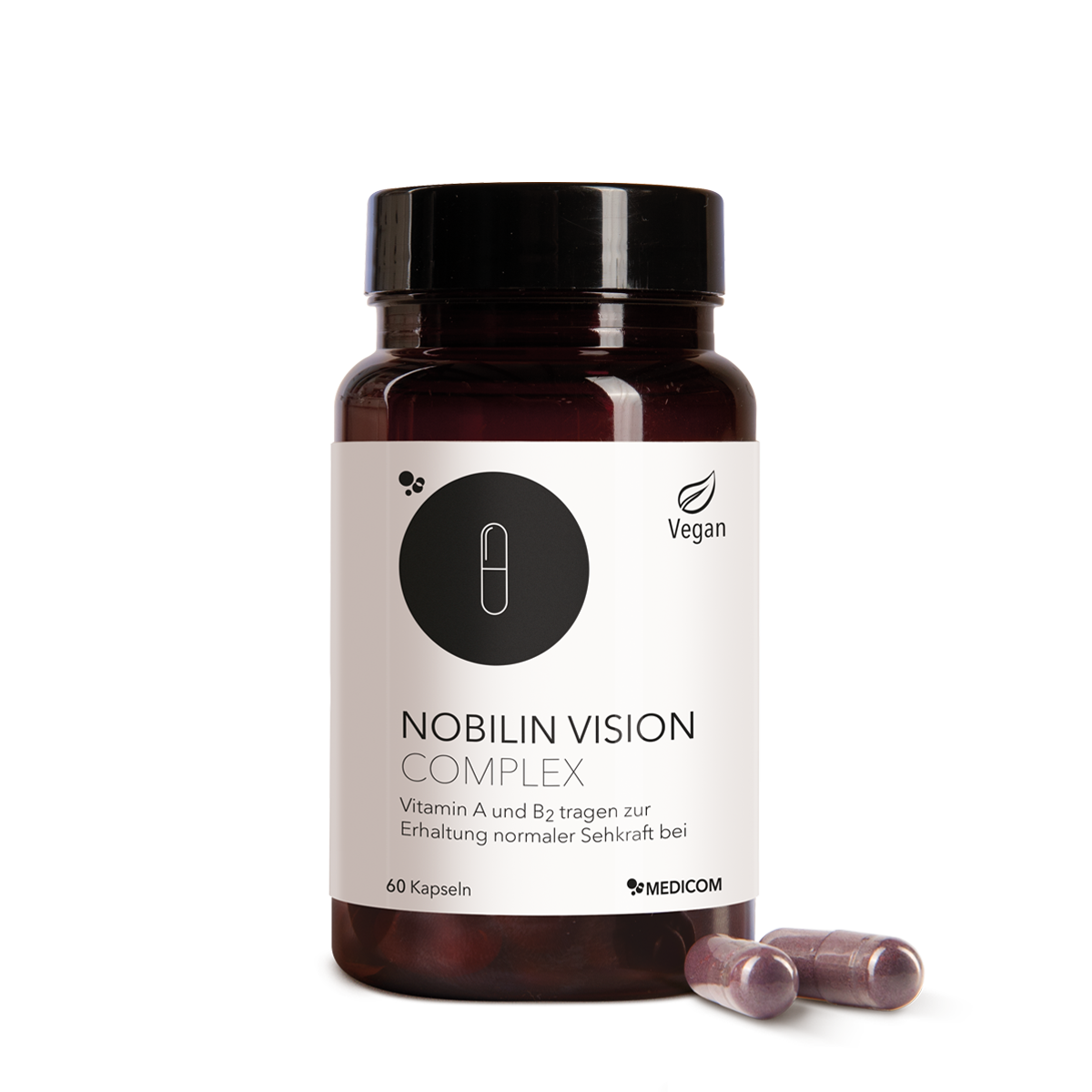
Nobilin Vision Complex
Eye vitamins + plant power for vision & focus
Medicom: Do you recommend naturopathic medications and dietary supplements?
Beate Rinderer: Yes. Our eyes do enormous work every day and can certainly use support. At the latest when they signal this through discomfort. Useful options include, for example, Schüßler salts and other homeopathic remedies for strengthening and detoxification. I also recommend zeolite (a natural volcanic rock) and eye vital nutrients such as lutein, zeaxanthin, vitamin D3, omega-3, taurine, vitamin E, coenzyme Q10, vitamin C, vitamin A, B vitamins, zinc, selenium, potassium, calcium, magnesium – certainly in high doses in the form of pharmacy-grade formulas. In addition, there are very helpful drops and ointments for supporting a wide variety of eye issues, e.g., with active ingredients from Euphrasia (our native eyebright), Calendula (our marigold), Chelidonium (greater celandine), and wild mallow, or with ingredients such as carnosine or DMSO.
Beate Rinderer: What role do lutein and zeaxanthin play in maintaining healthy eyes?
Beate Rinderer: A very large one, especially for the retina and the lens of our eyes. Both substances are an important protection against cataracts and the feared macular degeneration. We need them more urgently than ever, especially due to our lifestyle today, with screens of all kinds, including the frequently used cell phone. We receive these two active ingredients exclusively through plant-based food. It is precisely in the colored parts of fruits and vegetables that we find the important lutein and zeaxanthin. Therefore, for the preservation and support of healthy eyes, pay attention to a colorful diet: strong dark blue blueberries or the bright colors of red peppers, the green of vegetables and lettuce leaves. Red, orange, yellow, green, and blue are, quite literally, a feast for the eyes.
Medicom: Why do you recommend acupuncture for maintaining eyesight in your book?
Beate Rinderer: Acupuncture is the most efficient naturopathic treatment for eye problems currently available. Within naturopathy, acupuncture specifically developed for the eyes is unsurpassed in the therapy of the most diverse eye diseases. It is completely safe and thus a reliable and side-effect-free support for the eyes. Furthermore, it is also powerful in preventive healthcare for the eyes.
About the person:

Beate Rinderer is a graduate physicist and alternative practitioner. She worked for many years in the development of new laser technologies and procedures. Since 2006, she has been helping many people with a wide variety of eye problems in her specialized eye practice using a laser acupuncture therapy she further developed. The eye expert has written a book about how one can train their eyes. Her book "Natürlich besser sehen" was published in 2021 by Humboldt-Verlag, has 136 pages, and costs 19.99 euros or 18.99 euros as an eBook.

Are you interested in a recipe for an eye-healthy berry smoothie? Then the blueberry chia smoothie is just the right thing for you.
Do you want more information on eye products? You can learn more about them here.