We live in crazy times! Negative headlines are piling up: climate change, inflation, wars. Only a few people have the resilience to face these increasing psychological stressors unmoved. Here you will find the best Medicom expert tips: smartly combined vital substances! Put an end to restlessness, anxiety, and sleep problems.
In difficult times
The consequence: More and more people are suffering from mental and physical imbalance.
The trigger: Stress, anxiety, restlessness, hormonal changes, time changes, and the associated symptoms such as sleep disorders, depressive moods, and phases of exhaustion.
The remedy: Certain combinations of vital substances can help to find your way back to mental equilibrium and greater physical performance more quickly. Always in combination with a balanced diet, exercise, and supportive therapies. For example, if we sleep well, it reduces nervousness and exhaustion during the day.
But which of the countless vital substances and medicinal plants are really effective for stress, anxiety, and restlessness, and how should they be combined or what are they used for?
Medicom will help you find an answer to this question. Read on!
Why do dietary supplements make sense?
Support mental distress, mental exhaustion, and sleep problems additionally with essential micronutrients or medicinal plants
Everyone sleeps restlessly sometimes and has "bad mood" days. However, if you notice that you have been moving outside your comfort zone for a long time and restlessness accompanies your everyday life, you should take action. Try specifically combined and synergistically coordinated micronutrients and medicinal plants. Because when taken in time, they can influence your inner balance and help strengthen your mental resilience.
Compared to synthetic sleeping pills and psychotropic drugs, micronutrients and medicinal plants have the advantage that they harmonize gently and are generally free of undesirable side effects. If you do not experience any improvement and your mood and sleep continue to deteriorate, it is advisable to seek additional therapeutic or medical help. These "little helpers" do not replace therapy, but they can be a useful accompaniment.
How and which vital substances should you take?
For a healthy mental balance during increased stress and sleep problems
First, it is important to understand that a physical stress reaction leads to an increased need for certain micronutrients. It is certainly immediately obvious to you that an athlete requires more vital substances during maximum exertion than someone taking a walk. Now, the brain cannot distinguish whether stress arises from inner fears or whether an external "attack" is truly the trigger for the panic. The body activates all reserves and prepares for a "survival fight" against the threat. This costs a lot of energy. If the stress persists, we produce increased amounts of cortisol. Cortisol is the long-term stress hormone. However, permanently high cortisol levels also lead to negative physical effects such as
- elevated blood sugar levels
- decreased performance and immune defense
- high blood pressure
- increased inflammation markers
- inner restlessness
- sleep problems
- mental distress
While we may be sufficiently supplied with vital substances through our diet in "normal times," the need can be quite different and increase individually in stressful times. This concerns vitamins, minerals, trace elements, and amino acids. Various vital substances are involved in healthy mental function.
These include, for example:
- The mineral magnesium: Magnesium is considered the "relax" mineral, with which we literally "power down" again. It is considered essential for our autonomic nervous system and energy supply.
- The B vitamins: are indispensable for the adequate function of our nervous system and are partly involved in the synthesis of important neurotransmitters such as the "happiness hormone" serotonin (vitamin B6).
- The essential amino acid L-tryptophan: this is needed directly for the synthesis of serotonin.
- The "sleep hormone" melatonin: Melatonin is produced in the pineal gland and is, so to speak, involved in our "internal clock." It is released when it is dark and signals "bedtime." Its antagonist is cortisol, which is best for waking us up in the morning. Limited melatonin secretion can lead to sleep problems.
- The trace element zinc: Zinc is involved in over 300 enzyme processes in the body, including the regulation of important messenger substances such as dopamine and serotonin. A zinc deficiency can promote difficulty falling asleep and be involved in "restless leg syndrome."
Certain medicinal plants and plant-based adaptogens can also reduce stress and inner restlessness and support healthy sleep.
These include, for example:
- Lavender: among medicinal plants, it is "the mother who takes you in her arms." Lavender has anxiety-relieving and calming properties. Suitable for day and night.
- Valerian: helps to enable a good night's sleep and soothe the nervous system. This is partly because the ingredients in valerian have certain similarities to calming neurotransmitters (messenger substances of the nervous system) and promote their release.
- Hops: a medicinal plant whose benefits have been known since the 10th century. It alleviates nervousness and can also be used for sleep disorders. Due to synergistic effects, it is often combined with valerian.
- Lemon balm: this medicinal plant, also known as Melissa, is used to calm the autonomic nervous system and has both uplifting and calming properties. It is also used if one reacts to anxiety and restlessness with abdominal cramps or a nervous stomach.
- Passionflower: as a herbal medicine, the extract is often used to promote sleep and for states of restlessness as well as mental imbalance. Passionflower is used both during the day for nervousness and to improve sleep.
- Plant adaptogens: for example, Rhodiola rosea and ginseng strengthen resilience, i.e., physical and mental resistance to external influences, with their plant-based ingredients. They give you a "thicker skin."
The greatest positive effects are often achieved through the combination of micronutrients with synergistically supportive medicinal plants or adaptogens.
Medicom expert tip:
Nobilin Sleep – Promotes natural, healthy sleep. The product contains a pre-combined mix of lavender, passionflower, L-tryptophan, vitamin B6, and magnesium citrate.
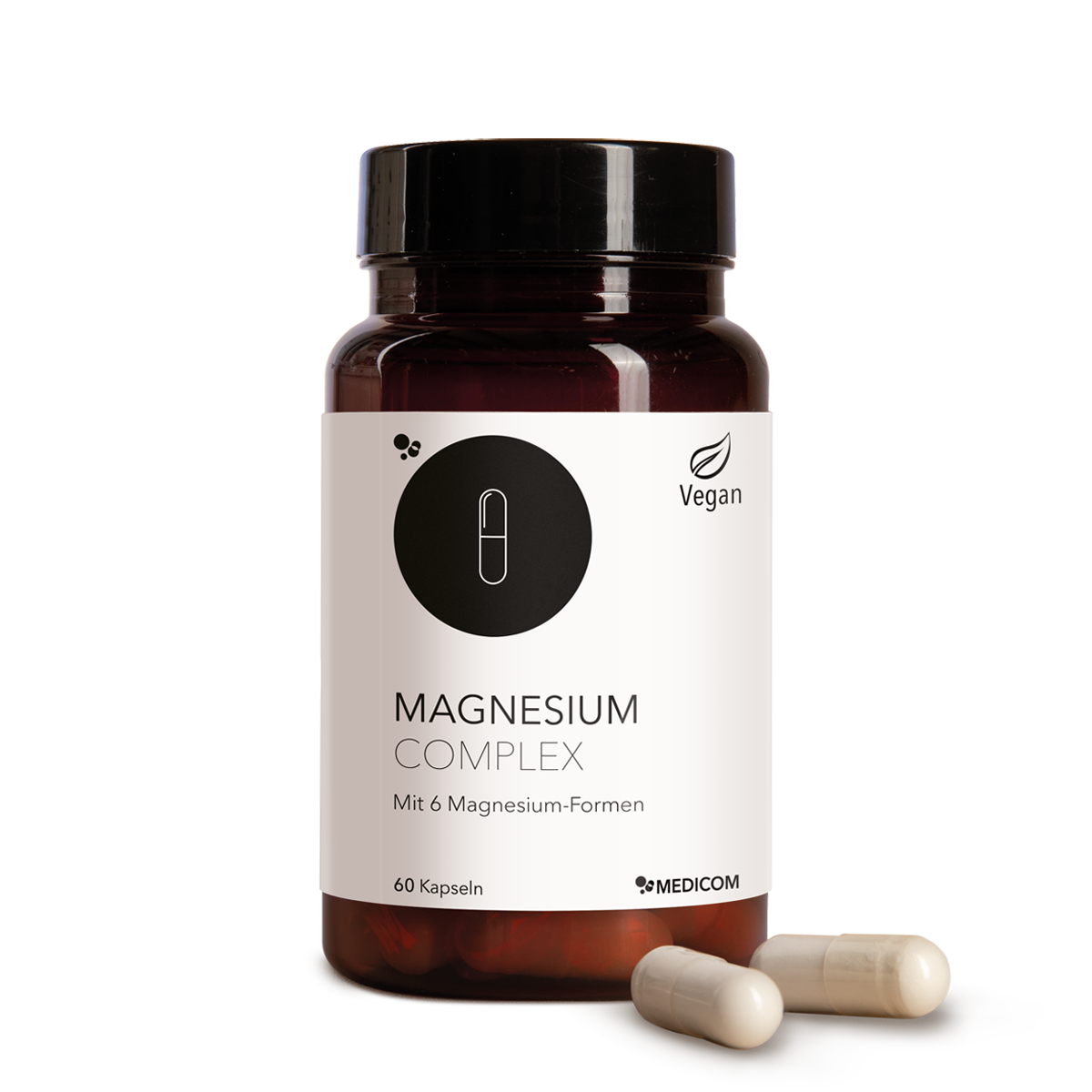
Magnesium Complex
6 forms of magnesium: stress, muscles and energy
When it is acute
How to support mental balance and sleep in the short term
Stress and restlessness often occur unexpectedly and can not only rob us of sleep but also catapult us out of our inner center.
In such situations, rapidly available combinations of vital substances have proven effective.
Tip for short-term effective help for the night: Medicom product combination of valerian/hops, melatonin, and magnesium citrate.
Valerian contains the body's own messenger substance GABA, which calms nerve cells and has anxiety-relieving properties. Hops is generally calming. Melatonin helps to shorten the time it takes to fall asleep, and magnesium is known as the "relax mineral." A particularly rapidly available compound is magnesium citrate.
Tip for short-term effective help for the day: Especially in stressful situations and the resulting inner restlessness, exhaustion, or anxiety and worries, a Medicom product combination of vitamin B12, magnesium citrate, and an adaptogen such as Rhodiola rosea and/or ashwagandha can be helpful.
Vitamin B12 is the nerve vitamin par excellence and is indispensable for normal mental function. Magnesium regulates the autonomic nervous system and also helps to restore "inner peace" during the day. Adaptogens are plant-based ingredients that can increase mental resilience.
Medicom expert tip:
Combination for the night: Combine the vital substances valerian/hops, melatonin, and magnesium citrate. Combination for the day: Combine the vital substances ashwagandha/Rhodiola rosea, B12, and magnesium citrate.
Prevention is better than cure
How to support mental balance and sleep in the long term
Anyone who wants to do something for their mental and psychological well-being in the long term and wants to sleep well should ensure a good supply of these micronutrients:
- Vitamin D3 is the "sun vitamin," where there is a risk of deficiency, especially in the dark months. A good supply is indispensable in stressful times of life. Vitamin D3 has, among other things, a central importance for the health of the nervous system and the psyche.
- Zinc is involved in the formation of important messenger substances of the nervous system. A zinc deficiency can also lead to falling melatonin levels.
- Magnesium is indispensable for a healthy psyche and normal function of the nervous system.
- Vitamin B12 is not only involved in blood formation and cell division but is also an elementary protection for the nerves. A long-standing B12 deficiency can lead to irreparable damage to the nervous system.
- Iron has other important functions in addition to oxygen transport and blood formation. Sleep, attention, mood, and concentration can also be impaired by an iron deficiency. With an iron deficiency, less of the nerve messenger substance dopamine is formed. Dopamine is considered the "messenger of happiness." An iron deficiency can be promoted by stress.
The combination of these vital substances with a plant-based adaptogen such as Rhodiola rosea, ashwagandha, or ginseng is also suitable in longer-lasting phases of stress and restlessness and can lead to better resilience to external demands, support the regulation of stress hormones, and positively influence sleep.
Medicom expert tip:
In longer-lasting stress phases that also promote sleep problems, combine these vital substances: Vitamin D3, vitamin B complex, magnesium citrate, and an adaptogen such as ginseng (strength), ashwagandha (inner peace/sleep), or Rhodiola rosea (balance).
What else to consider when taking vital substances
- Zinc as a dietary supplement is absorbed particularly well on an empty stomach, but can cause stomach upset and nausea. A good tip is therefore to take zinc in the evening, 1–2 hours after the last meal.
- Adaptogens such as Rhodiola rosea, ashwagandha, and ginseng should not be taken when simultaneously taking synthetic psychotropic drugs without consulting a doctor, as interactions are possible.
- Adaptogens such as Rhodiola rosea and ashwagandha can also be combined with each other. For example, Rhodiola rosea during the day for a balanced day and ashwagandha for restful sleep in the evening.
- Medicinal plants with sleep-promoting properties such as lavender or valerian should not be taken at the same time as synthetic sleeping pills.
- Zinc and iron as supplements should be taken with a time interval between them, as they can hinder each other's absorption. This does not apply if iron and zinc are ingested together as a component of food.
- Vitamin D3 can also be supplied as a depot. This means that instead of the daily recommended intake, a higher dose can be taken once a week. This is not possible if vitamin D3 is combined with vitamin K2 in one product. Co-factors for optimal absorption of vitamin D3 are magnesium and K2.
- Vitamins E, D, K, and A are among the fat-soluble vitamins. These can also be overdosed. If you are not sure whether you have an optimal vitamin D3 supply, you can have this value determined in your blood by a doctor.
Conclusion
Vital substances are involved in many ways in healthy mental function, the regulation of the nervous system, and the formation of certain messenger substances. In the case of deficiency, stress, anxiety, restlessness, and disturbed sleep, it can lead to a nervous and psychological imbalance with corresponding consequences. Especially in phases of increased tension, it is important to ensure that the body is sufficiently supplied with micronutrients.
In addition, smartly composed combinations of medicinal plants and micronutrients can lead to improved effects that support sleep and inner balance in a natural way. The right combination with each other is important. If you are unsure, seek expert advice on which composition of individual vital substances makes the most sense for you.
Are you interested in a podcast on the topic: How do I overcome crises? An expert interview with emergency and military psychologist Bernhard Penz.
Are you interested in products that support your relaxation and sleep? You can find more here.