Menopause is a completely natural episode in a woman's life. However, hormonal changes can become a major burden in everyday life for some women; among other things, they can lead to sleep disorders. Read on to find out what you can do for better sleep during hormonal shifts.
What do sleep disorders have to do with menopause?
Hormones are chemical messengers that can lead to psychological and physical changes when their levels shift. The shift in sex hormones can not only be "heated," but also promote psychologically and physically distressing sleep disorders. One of the most common symptoms women suffer from during menopause, alongside hot flashes, is the dreaded sleep disorder. Sleep is essential for our physical and mental health. Prolonged sleep disorders can therefore become a danger to our health.
When do women reach menopause?
The point at which women reach menopause (the climacteric) is not a fixed point in time, but rather an entire period that can be divided into three phases:
- Premenopause – the still-fertile phase directly before the onset of menopause, in which progesterone production usually begins to decline
- Perimenopause – when estrogen and progesterone production decrease; true menopause begins with the final menstrual period
- Postmenopause – begins at the time of menopause, i.e., immediately after the last menstrual period a woman has.
By the average age of 51, about 50 percent of women have reached postmenopause. Menopause is therefore an entire period of hormonal transition that a woman experiences before and after her final period. Both the duration and the timing are highly variable. For most women, hormonal changes begin as early as age 45.
What are typical signs that may indicate the beginning of a hormonal shift?
Examples include:
- Irregular periods, i.e., the reliability of the onset of menstruation changes – or stops altogether; cycles vary in length
- Hot flashes and night sweats
- Sleep disorders
- Inner restlessness
- Unexplained irritability or depressive moods
- Weight gain and increased water retention
Since not only menopause but also various medical conditions can be behind such symptoms, they should always be clarified by a doctor.
Why do sleep disorders often occur during a woman's menopause?
Because sleep disorders during menopause can be particularly distressing, this problem should be given special attention. Women at this age are often under high pressure not only in their families but also in their professional lives. Since the average age at which women have children today continues to rise, the onset of menopause may coincide with the care of dependent children and professional challenges. In such cases, sleep disorders, in particular, can be especially burdensome.
Both progesterone and estrogen have direct effects on sleep quality. Even in the first phase, i.e., when hormones first begin to shift relative to one another, sleep disorders often occur. Progesterone, which usually drops first, is colloquially referred to as the "chill hormone." If estrogen production in the ovaries also drops, not only can mood swing very quickly, but so can sleep quality. Among other things, estrogen has a direct influence on our psychological state and has a mood-lifting effect. Hot flashes are also promoted by the drop in estrogen, which significantly impairs sleep quality.

Nobilin Sleep
Fall asleep and sleep through the night faster
Why should women see a doctor for persistent sleep disorders during menopause?
Even if the root cause of sleep disorders during menopause is natural processes and they usually settle on their own or with natural aids, they can still be particularly distressing for some women.
Persistent sleep disorders can become not only a psychological burden but also a physical risk. Statistically, those who do not get enough sleep over a long period have a higher risk of cardiovascular and metabolic diseases. In addition, too little sleep can lead to a weakened immune system, making us more susceptible to infectious diseases.
In this case, hormone replacement therapy can be helpful. Although this is not undisputed and is a subject of controversial discussion, it is always a matter of weighing benefits and risks, which the gynecologist must carefully assess based on the individual's level of suffering.
What can you do yourself about sleep disorders during menopause?
It is important to realize at the beginning of the hormonal shift that a completely natural new phase of life is beginning. "Going through menopause" is a process that most women's bodies adjust to on their own after a certain amount of time.
Since many women are also haunted by the idea of becoming old and unattractive at the start of menopause, the "mindset" here should not be underestimated. Such nonsensical ideas and thoughts can also burden the psyche and thus sleep. If we stay physically active, eat a healthy diet, and ensure adequate stress relief, the hormonal shift will not be able to harm us in most cases. By no means do all women suffer from distressing symptoms during menopause, and if they do, professional help is available. So, do not let unreasonable fears rob you of sleep; try supportive measures instead:
- Guided meditations
- Yoga
- Mindfulness exercises
- Naturopathic measures such as TCM, homeopathy, phytotherapy (professional consultation is important)
- Regular balancing exercise such as swimming, cycling, or running
- A healthy diet rich in phytoestrogens (especially isoflavones and lignans). These include, for example, soybeans, tofu, soy milk, miso, flaxseeds, pumpkin seeds, peas, nuts, olives, cauliflower, broccoli, and many more.
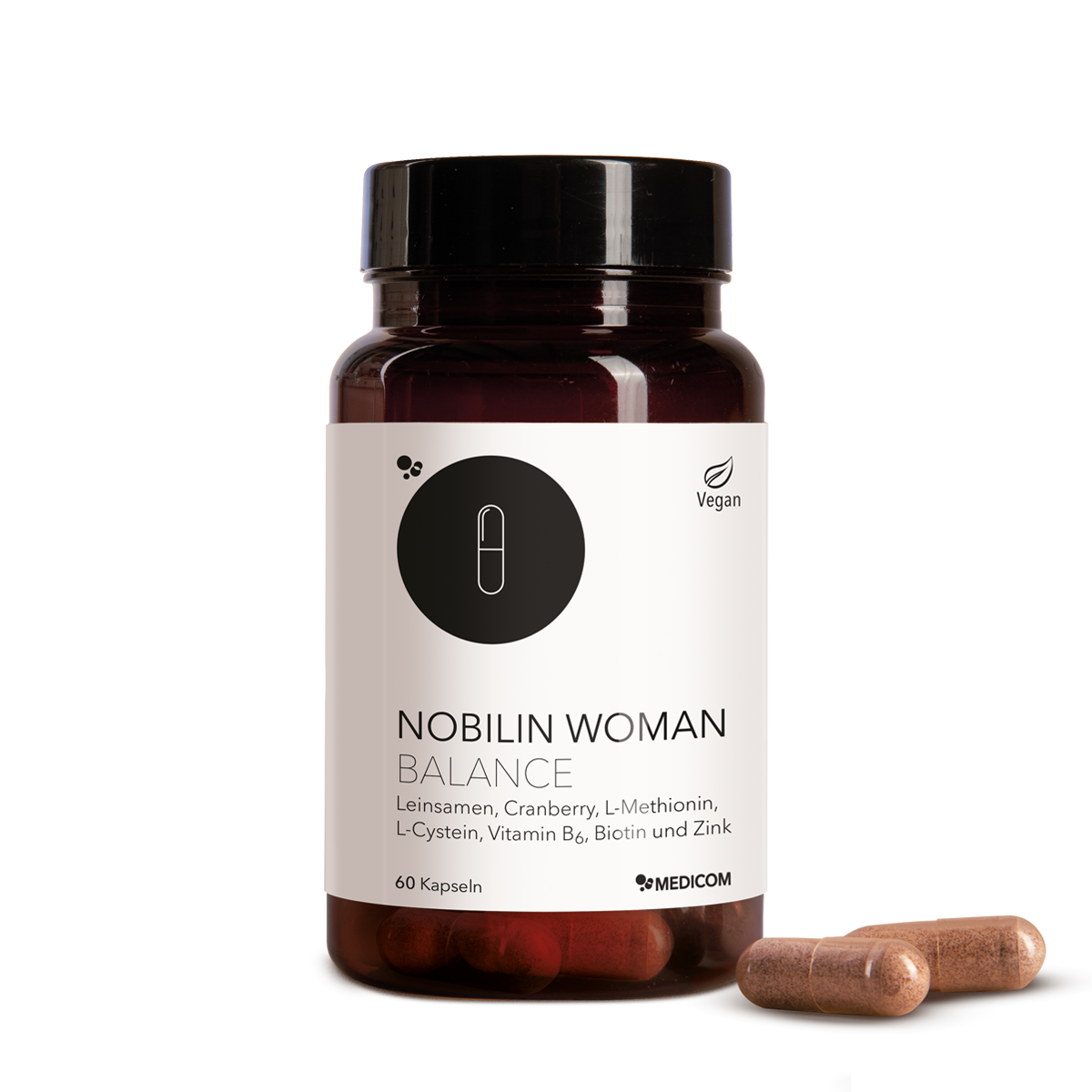
Nobilin Woman Balance
For the balance of women
Although plant-based estrogens in food act much more weakly than "real" hormones, a diet rich in these secondary plant compounds can certainly contribute to a better internal balance during menopause and thus positively influence sleep.
Which micronutrients and medicinal plants can have a positive effect on sleep disorders during menopause?
There are many micronutrients and herbal aids that can positively support the transition through menopause.
For general and long-term support during hormonal shifts, for example, isoflavones and lignans (phytoestrogens), omega-3 fatty acids (found in fatty fish, krill, and algae), and gamma-linolenic acid (e.g., borage or evening primrose oil) are suitable, as is a good supply of vital substances such as vitamin D3, which is required for the synthesis of sex hormones.
Certain plant substances and selected micronutrients help to directly improve sleep quality.
Examples of important micronutrients to support sleep problems during menopause:
- Vitamin B6: required for the synthesis of the messenger substance serotonin; serotonin, in turn, is involved in the production of the "sleep hormone" melatonin.
- Magnesium: Magnesium is the "relax mineral" and is essential for nerve function. Symptoms of a magnesium deficiency can include sleep disorders. For mild sleep problems, one can always try taking an additional dose of a highly bioavailable magnesium compound, such as magnesium citrate, right before going to bed.
- L-tryptophan/melatonin: L-tryptophan is an essential amino acid that is converted in the body into serotonin, the "happiness hormone," which in turn is used to create melatonin. L-tryptophan is found in various foods and is also available as a dietary supplement. Melatonin itself can also be taken as a low-dose dietary supplement, approximately 30 minutes before sleep.
- Vitamin B12: the "nerve vitamin" B12 is not only essential for the overall functioning of the nervous system but is also said to favorably influence the "sleep-wake rhythm."
- Zinc: This trace element is involved in the functioning of important neurotransmitters (messenger substances), among other things. These include GABA, glycine, and dopamine. A study by Korean scientists published in 2012 showed that higher zinc levels could positively influence sleep duration in women. Furthermore, a zinc deficiency can promote "restless leg" syndrome.
Nobilin Sleep
Fall asleep and sleep through the night faster
Examples of important herbal preparations for improved sleep quality are:
- Lavender: specifically, oil extracted from lavender is known for its calming and sleep-promoting effects. This has been proven in studies. Lavender is available as a medicinal product and a dietary supplement. Lavender oil is said to be particularly helpful for anxieties and worries that can negatively affect sleep quality. A longer duration of use is important.
- Lemon balm: helps primarily with inner restlessness and irritability. Its relaxing effect can positively influence sleep quality and reduce stress through the calming properties of the lemon balm plant.
- Hops: is a wonderful medicinal plant that has stress-relieving, calming, and sleep-promoting properties. Hops not only have a relaxing effect but are also said to help with menopausal symptoms. This was proven by a study from Finland in 2010. After 8 weeks of intake, typical menopausal symptoms were significantly reduced compared to the placebo group. The effect was attributed to the natural phytoestrogen content of hops.
- Valerian: Valerian contains the neurotransmitter GABA (gamma-aminobutyric acid). This inhibits overactive nerve cells, which has a calming effect and can alleviate difficulty falling asleep. The positive properties of hops and valerian are often used in combination preparations to utilize synergistic effects.
- Passionflower extract: The passionflower was chosen as the Medicinal Plant of the Year by the University of Würzburg in 2011. This is due to its many positive properties, particularly with regard to the psyche. Passionflower helps with the inner restlessness and sleep problems that are typical of menopause. It is also characterized by very good tolerability.
Conclusion
Menopause is a natural process in a woman's life. However, it can become burdensome if the body does not manage to settle adequately into a new hormonal balance. This varies completely from woman to woman and can range from no symptoms or almost no symptoms to massive levels of distress that severely impair quality of life.
Sleep disorders, in particular, are dreaded during menopause. They are felt to be especially distressing. A combination of medicinal plants and synergistically supportive micronutrients can often provide relief for sleep problems during the time of hormonal transition. It is easiest to use these little "helpers" together in a sensibly composed combination preparation. During the time of hormonal change, a longer duration of use may be necessary. Should the symptoms nevertheless persist and the distressing sleep disorders not disappear even after weeks, a visit to the doctor is sensible and necessary.
You can hear the most important facts and data on the subject of sleep in the podcast Sleep is Brain Detox with sleep researcher Dr. med. Michael Feld.
Are you interested in products that support your relaxation and sleep? You will find what you are looking for here.