Cholesterol remains a major topic when it comes to our health. After all, high levels are considered a central long-term risk factor – especially regarding cardiovascular diseases. However, nutritional medicine expert Prof. Dr. Michaela Döll suggests taking a closer look. In this Medicom interview, she talks about "good" and "bad" cholesterol, helpful natural remedies, and health as a complex interplay.
You can listen to the long version of the interview as a podcast here or read the abridged version of the interview further down.

Medicom: You have dedicated an entire book to the topic of "cholesterol." Why?
Prof. Dr. Döll: There are several reasons. For one thing, many people are worried about their cholesterol levels; for another, there are a few myths I wanted to debunk with the book. Also, cholesterol is simply a highly fascinating substance that fulfills many roles in our organism but can also fall out of balance. That is a complex matter, however, and cannot be solved by "just cutting out the butter." You can easily write a whole book about that.
Medicom: To start: What is cholesterol anyway, and what functions does it perform in our organism?
Cholesterol plays an important role in the formation of hormones and ensures "flow" in the brain.
Prof. Dr. Döll: Cholesterol is a vital natural substance that many people classify as a fat. Chemically speaking, however, it belongs to the group of alcohols. Due to its properties, it is correct to refer to it as a "fat-like natural substance." It has numerous functions. For example, cholesterol is a component of our cell membranes. It plays an important role in the formation of hormones and ensures flow in the brain by, for example, being responsible for the formation of new synapses. Neurosteroids, which co-regulate our brain metabolism, also require cholesterol to be formed or active. Furthermore, cholesterol is the building block that forms Vitamin D under the influence of UV radiation.
Medicom: If cholesterol has so many important functions, why is a high level considered so harmful?
When there is "too much" cholesterol, vascular changes occur where plaques are formed.
Prof. Dr. Döll: Now it gets a bit complicated. A high cholesterol level alone is not necessarily an alarming sign, even if people used to think so. You must always view this value in connection with other factors. Simplified, one can say that an "excess" of cholesterol leads to vascular changes where (under the influence of inflammation) plaques are formed. This narrows the vessels, which in turn increases the risk of cardiovascular diseases such as heart attacks. In Germany, the limit for a safe cholesterol level is 160 milligrams per deciliter (mg/dl) of blood. Lean non-smokers who do not fall into any other risk group may well have a slightly higher level. The total value is not necessarily the decisive factor. One must distinguish between HDL cholesterol and LDL cholesterol.
Medicom: Are those the two types of cholesterol referred to as "good" and "bad"?
Prof. Dr. Döll: Exactly. It is about the density of the respective particles in which cholesterol is transported through the organism together with protein. HDL stands for High-Density Lipoprotein, meaning a high density of the particles. LDL, on the other hand, refers to Low-Density Lipoproteins. HDL transports excess cholesterol from the blood to the liver, where it is broken down. LDL, conversely, brings cholesterol from the liver via the blood to the tissues, where the aforementioned inflammation-related deposits can occur. And then there is oxidized cholesterol. These are cholesterol molecules that have been damaged or rendered non-functional by free radicals—highly aggressive metabolic byproducts. This oxidized version also gets deposited.
Medicom: How does one prevent this? By giving up butter, eggs, and currywurst?
Prof. Dr. Döll: Unfortunately, that doesn't do much because cholesterol levels can hardly be influenced "from the outside." The body produces the largest portion in the liver itself. And if I now consume less cholesterol through food, the body compensates by increasing its own cholesterol production. Permanently elevated blood lipid levels are referred to in medicine as dyslipidemia. And that requires a well-thought-out therapy.
Medicom: What do you advise?
Prof. Dr. Döll: Many factors play a role. For one, a healthy gut microbiome is important. This is where the well-known probiotics come into play. On the other hand, it is about consuming substances that help to regulate cholesterol levels naturally. These include the bitter compounds in artichokes or bergamot. And also choline and omega-3 fatty acids, as I find them highly concentrated in krill oil.
The point is to provide substances that help regulate cholesterol levels in a natural way.
Medicom: You mention choline as an important nutrient. What is that, anyway?
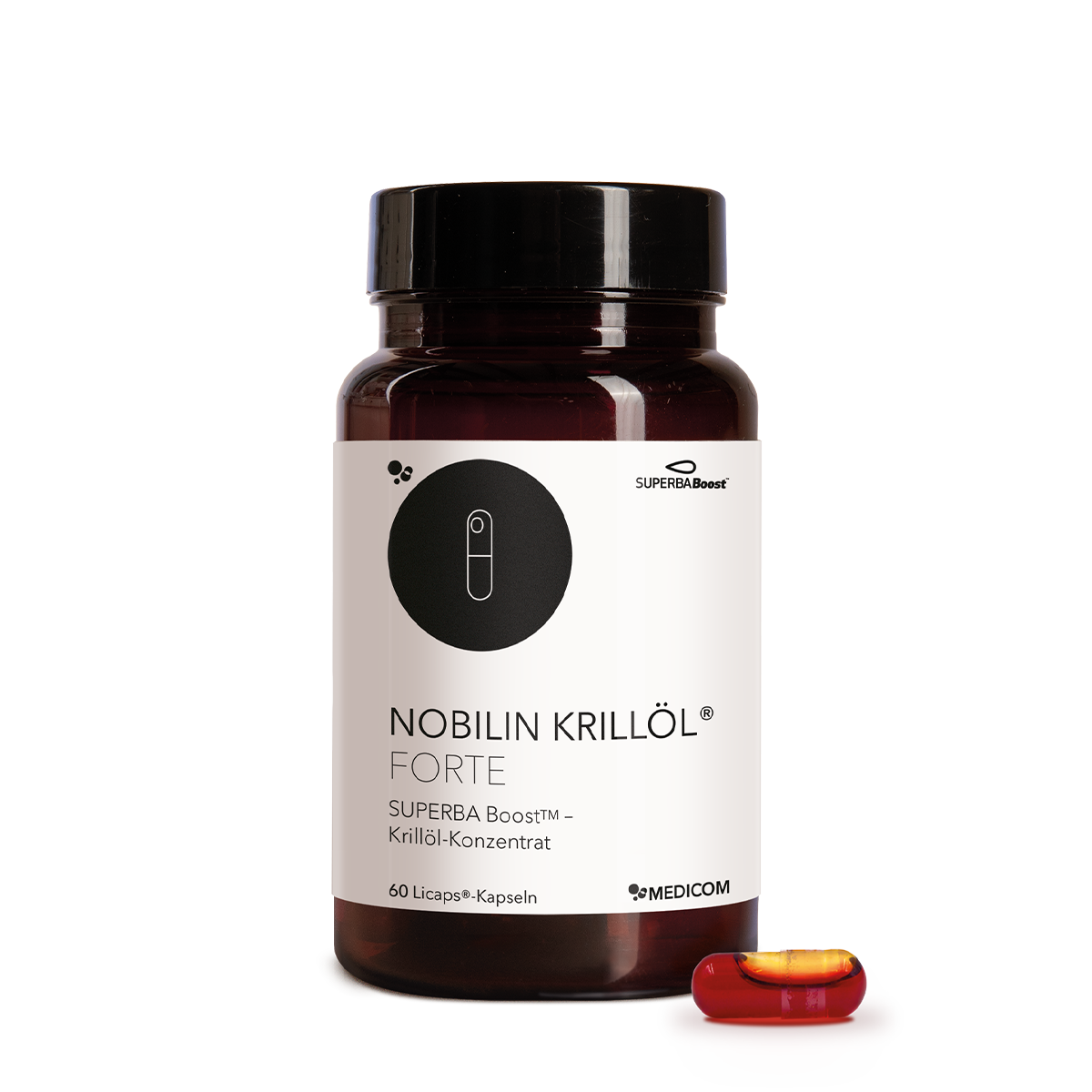
Nobilin Krill Oil® Forte
The best source of omega-3 in capsule form
Prof. Dr. Döll: Choline is a natural substance that our cell membranes are also built from. And it is a protective building block for nerve cells and the brain. Phospholipids, to which phosphatidylcholine belongs, are very important for the flexibility of our cells and for communication within the nerve cells. Choline itself is also needed for the transport of fats, for example, triglycerides from the liver to the target organs. This means: Choline also has significance in the transport of fat.
Choline also plays a role in the transport of fat.
Medicom: And where do I find choline?
Prof. Dr. Döll: The classic source is cod liver oil. Nowadays, no one should take that because cod liver oil can be heavily contaminated with pollutants. However, krill oil is indeed a very, very good source for phosphatidylcholine and for phospholipids in general. With krill oil, the omega-3 fatty acids are embedded in phospholipids. This has a major advantage because it allows the omega-3 fatty acids from the krill oil to be absorbed particularly well into the blood via the intestine, meaning they are utilized exceptionally well. Furthermore, when using krill oil as a source of omega-3 fatty acids, you don't get the burping that is common when taking regular fish oil capsules.
Medicom: Regarding a well-regulated cholesterol level, what is your opinion on consuming so-called medicinal mushrooms?
Prof. Dr. Döll: Very much so! There is a reason why certain mushrooms have had a firm place in folk medicine for thousands of years. Their ingredients can indeed show a favorable influence on lipid metabolism and the vascular system. Some varieties improve the flow properties of the blood and can contribute to lowering cholesterol levels.
There is a reason why certain mushrooms have had a firm place in folk medicine for thousands of years.
Medicom: Which mushrooms are considered medicinal mushrooms due to their ingredients?
Prof. Dr. Döll: One example is the glossy ganoderma—also known as the Reishi mushroom. Then there are the shiitake and maitake mushrooms. These are particularly well-known representatives. There are quite a few more, such as the Chinese caterpillar fungus or the agaricus blazei (sun mushroom).
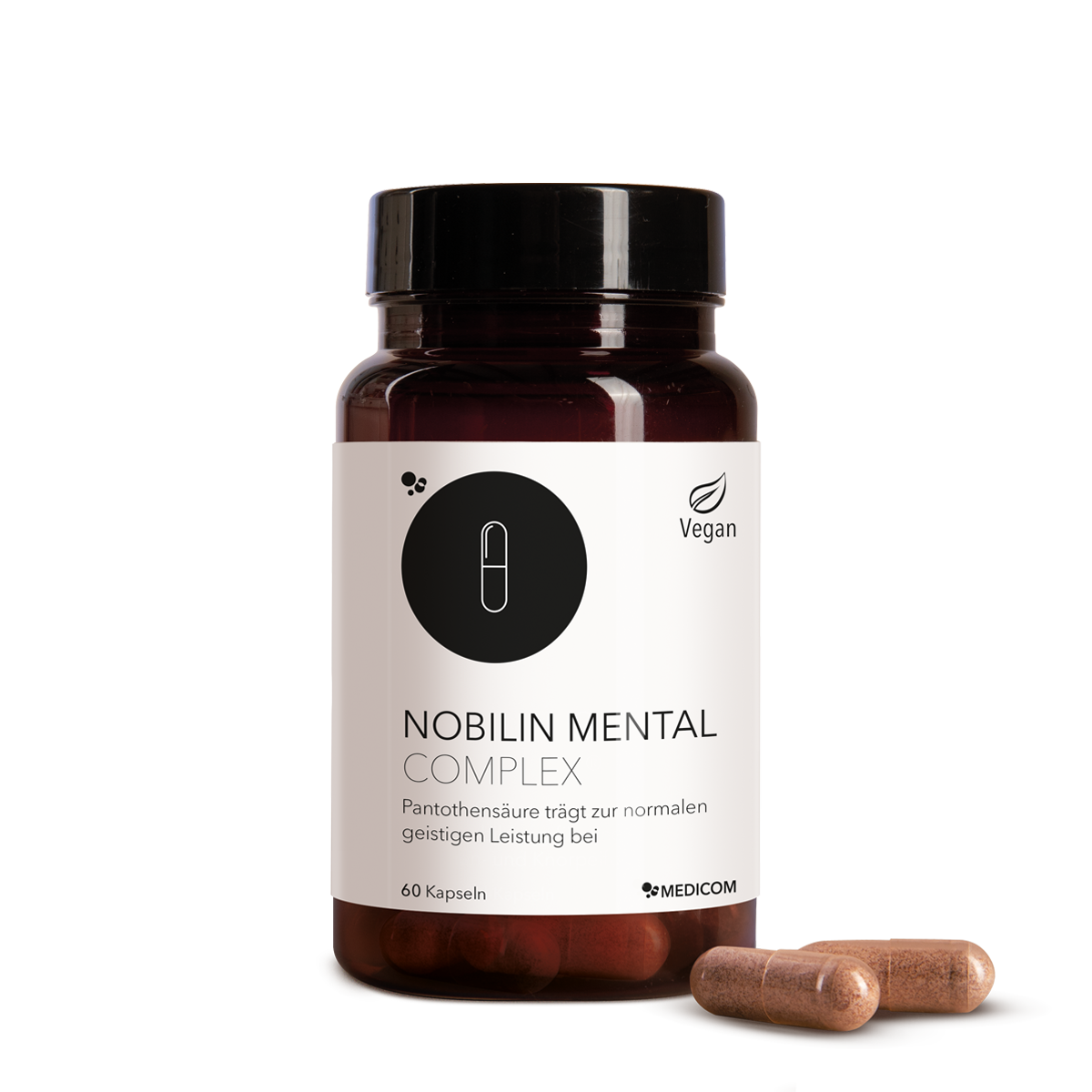
Nobilin Mental Complex
With Lion's Mane medicinal mushroom & 4 B vitamins for the brain
Medicom: In addition to the natural remedies mentioned, there are statins as a medication for high cholesterol levels. What are the arguments against statins as cholesterol-lowering drugs?
The list of possible side effects for statins is long.
Prof. Dr. Döll: For one, the list of possible side effects is long. For another, there are indications that statins may increase the risk of type 2 diabetes. Statins can also trigger muscle pain and temporarily impair memory performance. But it is also important to me that: Dyslipidemia should not simply be fought with a pill. Instead, one should consciously focus on a nutrient-rich diet with "good" fats, less stress, and more exercise. Most of the time, unfavorable lifestyle factors contribute to lipid metabolism disorders, and one should definitely also pay attention to maintaining a healthy weight.
About the interviewee: Michaela Döll is a professor of food chemistry and an internationally sought-after expert in nutritional medicine. Her main areas of work are nutrition, vital substance medicine, and diseases of civilization. This is also evident in her current book "Cholesterol Under Control" (Südwest-Verlag). In it, she clarifies all important questions regarding this fat-like natural substance.
Are you interested in products containing krill oil? You can find them here.
Would you like to know more about lipid metabolism and metabolic syndrome?